University of Texas at Austin

News

Oden Institute 2026 Moncrief Grand Challenge Awardees Announced

Published April 24, 2026

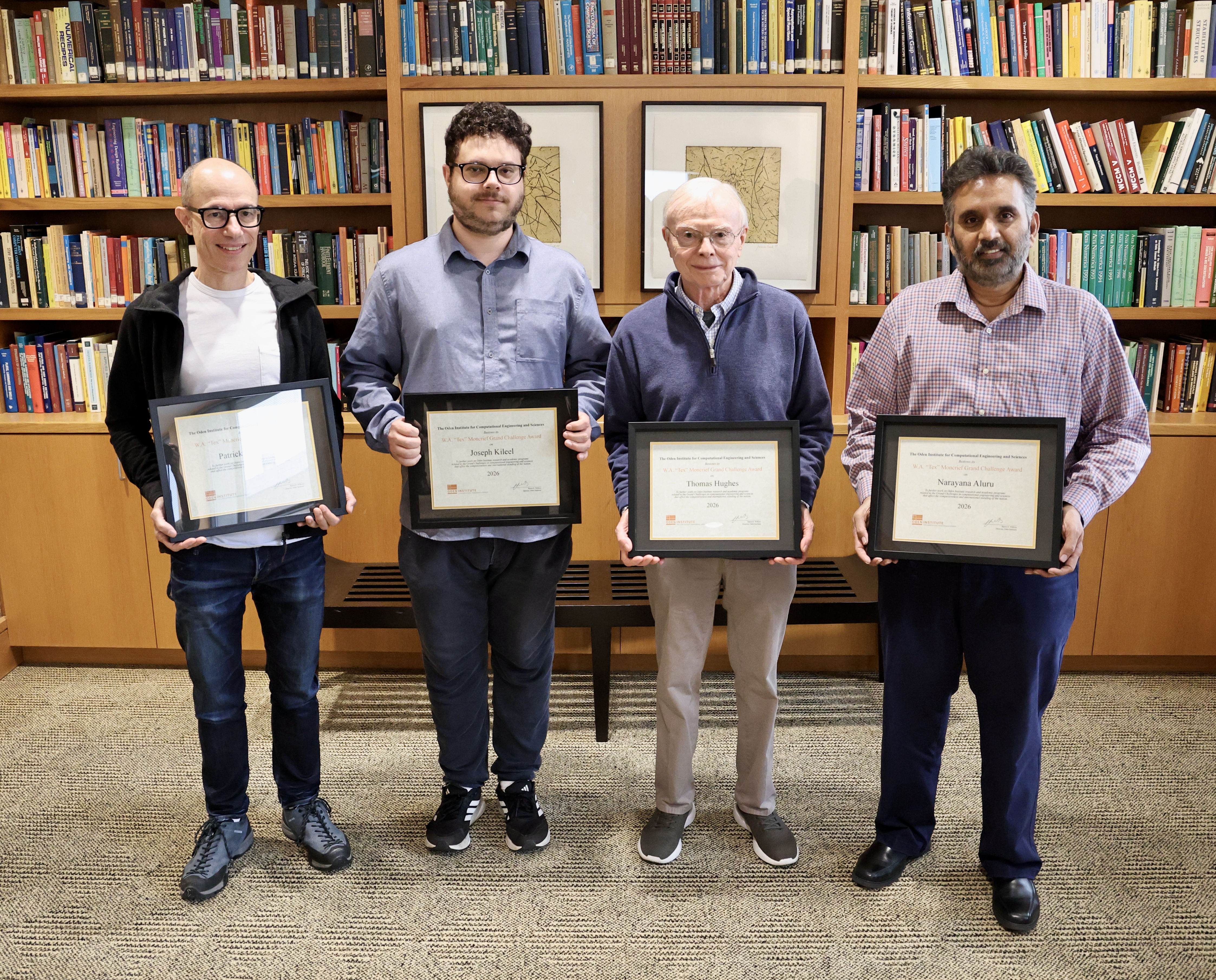
Patrick Heimbach, Joseph Kileel, Thomas J. R. Hughes, and Narayana R. Aluru. Credit: Joanne Foote

The Oden Institute for Computational Engineering and Sciences has named four faculty members as recipients of the 2026 W. A. “Tex” Moncrief Grand Challenge Awards. Narayana R. Aluru, Patrick Heimbach, Thomas J. R. Hughes, and Joseph Kileel were selected for research projects spanning brain-inspired computing, climate modeling, cancer forecasting, and scientific machine learning.

Established to give Oden Institute faculty the time and focus to pursue computational research on grand challenges in engineering, the sciences, and medicine, the Moncrief Grand Challenge Award honors the legacy of William “Tex” Moncrief Jr., a prominent businessman known for his lifelong passion for advancing science.

Narayana R. Aluru

Aluru, professor of mechanical engineering and director of the Multiscale Engineering, Mathematics and Sciences Group at the Oden Institute, is pursuing a new approach to brain-inspired computing. Neuromorphic computing has been an active area of research for years, but most existing architectures rely on electron transport through solid materials. The brain, however, uses ions moving through aqueous solution, and Aluru’s research group is building on that principle by creating ionic memristors, or resistors with memory, to mimic the synaptic functionality of the brain. 

“It is truly a tremendous honor to receive this highly prestigious recognition from the Oden Institute,” said Aluru. “This award will help us take the next step in charting the path forward for ionic computing.”

With this award, Aluru will design energy-efficient ionic memristors using multiscale computational approaches that combine quantum and continuum methods, and explore their use as computing elements for AI tasks such as recognition and classification that are currently performed on digital computers. The work directly addresses the rapidly growing power consumption demands of modern AI, and he anticipates the research will align with priorities at the Department of Energy (DOE), Department of Defense (DOD), and National Science Foundation (NSF).

Patrick Heimbach

Heimbach a professor of earth and planetary sciences, leads the Computational Research in Ice and Ocean Systems (CRIOS) group at the Oden Institute. His group builds computer models of the ocean and climate system. Using those models, they develop mathematical tools that allow models to efficiently learn from observations, adjusting uncertain inputs so simulations better reflect what satellites and in-situ (on-site) instruments reveal about the Earth. Much of his recent work, under the Differentiable Programming in Julia for Earth System Models (DJ4Earth) program, centers on a new generation of climate models written in Julia, a programming language. They are designed to run natively on GPU- and TPU-accelerated cloud hardware. 

“It is an honor to be selected for the Moncrief Grand Challenge,” said Heimbach. “The award gives me the time and focus to push the vision of the DJ4Earth program: to bring together inverse modeling, scientific machine learning, and GPU-native, data-constrained ocean climate simulation. I hope that my group can establish a novel computational framework that will move the needle on how confidently we can simulate the Earth system.”

With this award, Heimbach will extend his differentiable ocean framework to a coupled ocean–sea ice–atmosphere system, develop machine-learned replacements for traditional subgrid physics, and incorporate Hessian-based uncertainty quantification within the hybrid system. The framework is particularly well suited to ingest NASA satellite observations of the ocean and cryosphere alongside in-situ observing networks, and could serve as a simulation-based integration framework for the Global Ocean Observing System. He anticipates the work will benefit coastal planners, the insurance and reinsurance industry, water and energy managers, the blue ocean economy, and national-security agencies assessing climate-induced risk.

Thomas J. R. Hughes

Hughes, professor of aerospace engineering and engineering mechanics, lead of the Computational Mechanics Group, as well as a member of the Willerson Center for Cardiovascular Modeling and Simulation at the Oden Institute, is directing his award toward a pressing clinical challenge: metastatic prostate cancer. Although modern imaging techniques can detect metastatic tumors with remarkable precision, physicians still lack reliable tools to predict how an individual patient’s cancer will progress or respond to treatment, meaning therapy adjustments are often made only after significant disease progression. 

Hughes said that unlike most cancers, “prostate cancer is currently increasing in incidence and mortality. Approximately one out of seven men will be diagnosed with prostate cancer sometime in their lives. The five-year survival rate of metastatic prostate cancer is about 37%.”

“The Moncrief Grand Challenge Award will enable me to research the topic of metastatic prostate cancer using a combination of biomechanical and AI technologies to develop patient-specific digital twins to guide and improve individual treatment and thereby increase survivability. The work is in collaboration with a team from MD Anderson Cancer Center in Houston and colleagues here in Oden and abroad,” said Hughes.

With this award, Hughes will develop a personalized computational “digital twin” of metastatic prostate cancer, combining advanced mathematical modeling with clinical data — including PSMA-PET/CT imaging, blood-based PSA measurements, and molecular information — to forecast tumor progression and detect treatment resistance earlier than current standard-of-care approaches allow. The project will lay the foundation for predictive tools that could enable timelier, precision-guided treatment decisions and ultimately improve outcomes for patients with advanced disease.

Joseph Kileel

Kileel, assistant professor of mathematics and principal faculty member at the Oden Institute, is working to bring tensor networks into the mainstream of scientific machine learning. The tensor network approach encodes high-order mathematical objects as contractions of several low-order ones, offering more scalable alternatives to popular neural network representations of high-dimensional data with stronger mathematical guarantees. Applications of his research include contributing to methods in cryo-electron microscopy, as well as computer vision and robotics.

“Being selected for this is an honor for me, especially given the incredible caliber of others at Oden,” said Kileel.

His group has worked extensively with low-rank tensor compressions and is now branching into imposing structure within neural networks themselves. With this award, Kileel plans to develop tensor network–structured neural networks, efficient methods for training them, and applications that push scientific machine learning toward problems with large physical dimensions, including novel solution operators for high-dimensional partial differential equations and algorithms for ground state energy calculations in quantum many-body systems. He anticipates the research will benefit quantum chemists as well as researchers in control and electrical engineering, and sees strong alignment with the priorities of the DOE and NSF.

The Moncrief Grand Challenge Award is open to principal, core, and affiliated faculty at the Oden Institute. Recipients are chosen for proposals that address grand challenges “affecting the competitiveness and international standing of the nation. Awardees receive a stipend to support their work. At the end of each project, awardees prepare a final report summarizing their accomplishments.

A full list of current and past Moncrief Grand Challenge recipients is available here.