University of Texas at Austin

News

From Student to Scientist: Inside the 2026 Moncrief Summer Internship

Published Aug. 19, 2026

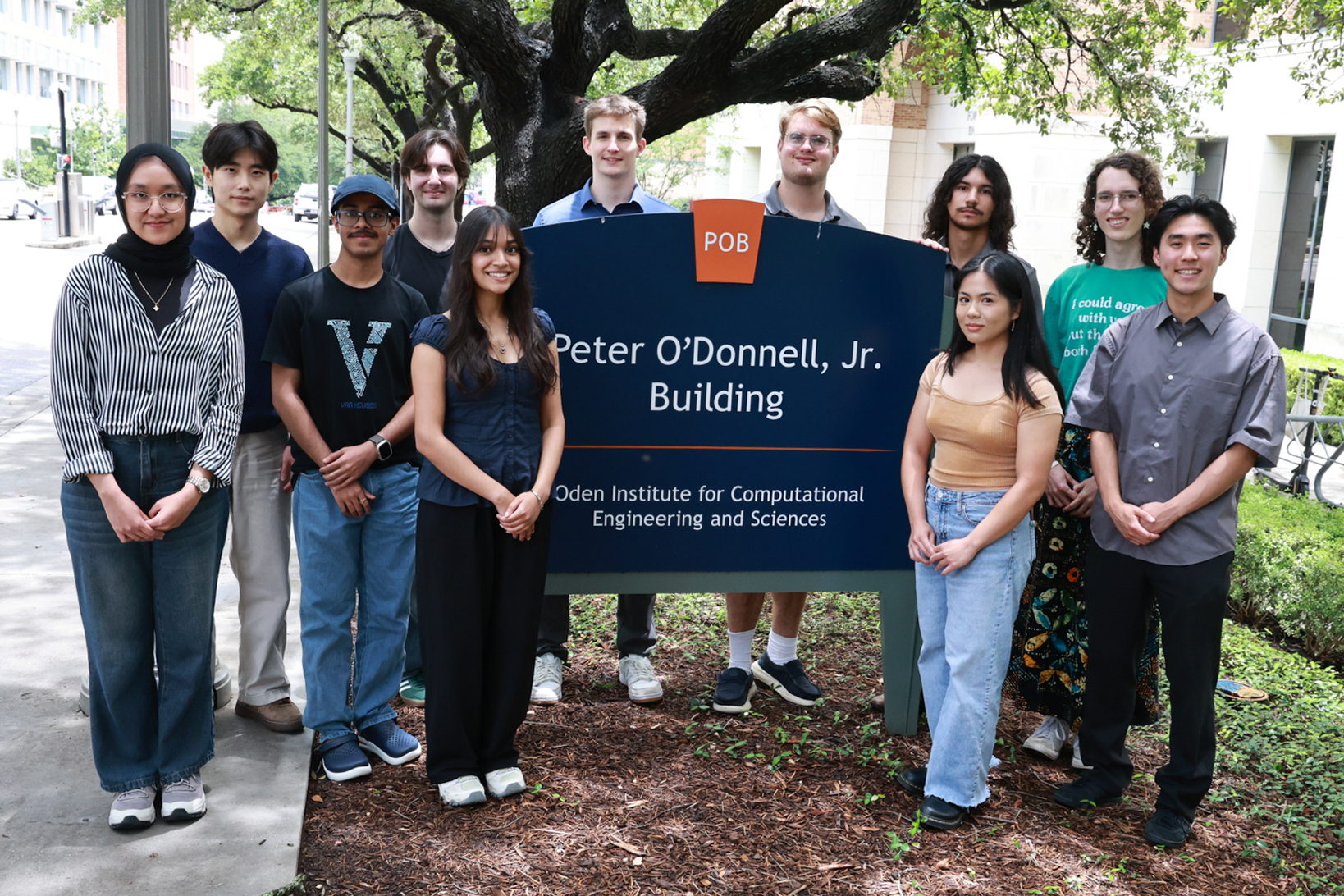
L-r: Nadine Nugroho, Jinsoo Cho, Archit Patil, Lonoehu Wacasey, Saniya Chaudhari, Chase Griffin, Micah Lee, Tomas Gutierrez, Dara Cheng, Olivia Kilday, Arata Ishikawa. Credit: Joanne Foote.

This summer, 11 undergraduates arrived at the Oden Institute for Computational Engineering and Sciences from across The University of Texas at Austin, the nation, and beyond to spend ten weeks doing what researchers do every day: confronting questions without obvious answers. Through the Moncrief Undergraduate Summer Internship Program, interns are paired with a faculty-led research group and work alongside a mentor. By summer’s end, the most valuable lessons were rarely tied to a single discovery. Instead, interns learned how research really works: what to do when there's no clear-cut answer, how to turn a stack of papers into a plan, and realizing that the right questions can be more powerful than the right answer. 

During the program, interns work with mentors who help them navigate going from a student mindset to taking on the mindset of a researcher and learning how to contribute within a research group. Meeting with mentors provides the opportunity to learn how to navigate ambiguity as they tackle real-world problems.

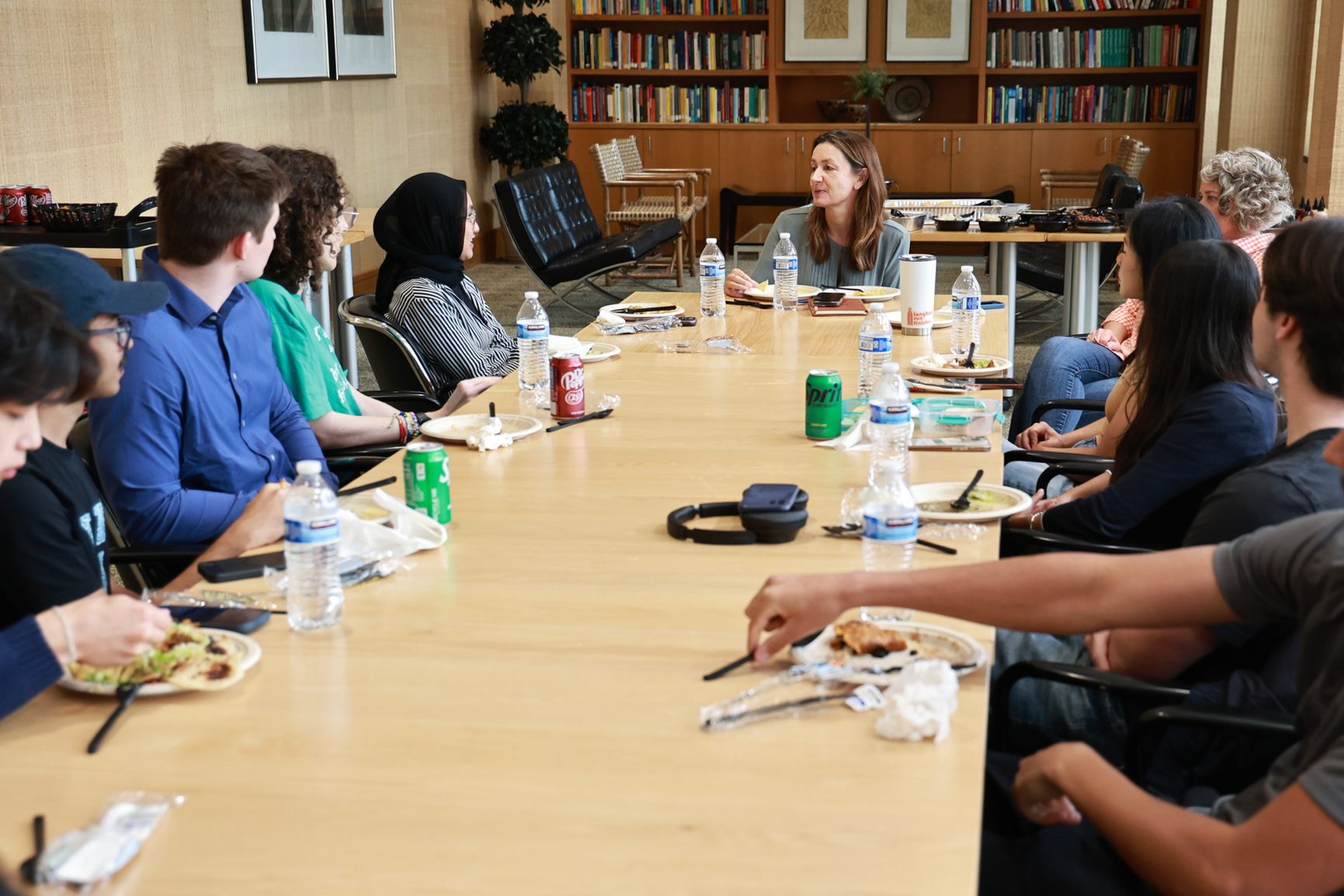
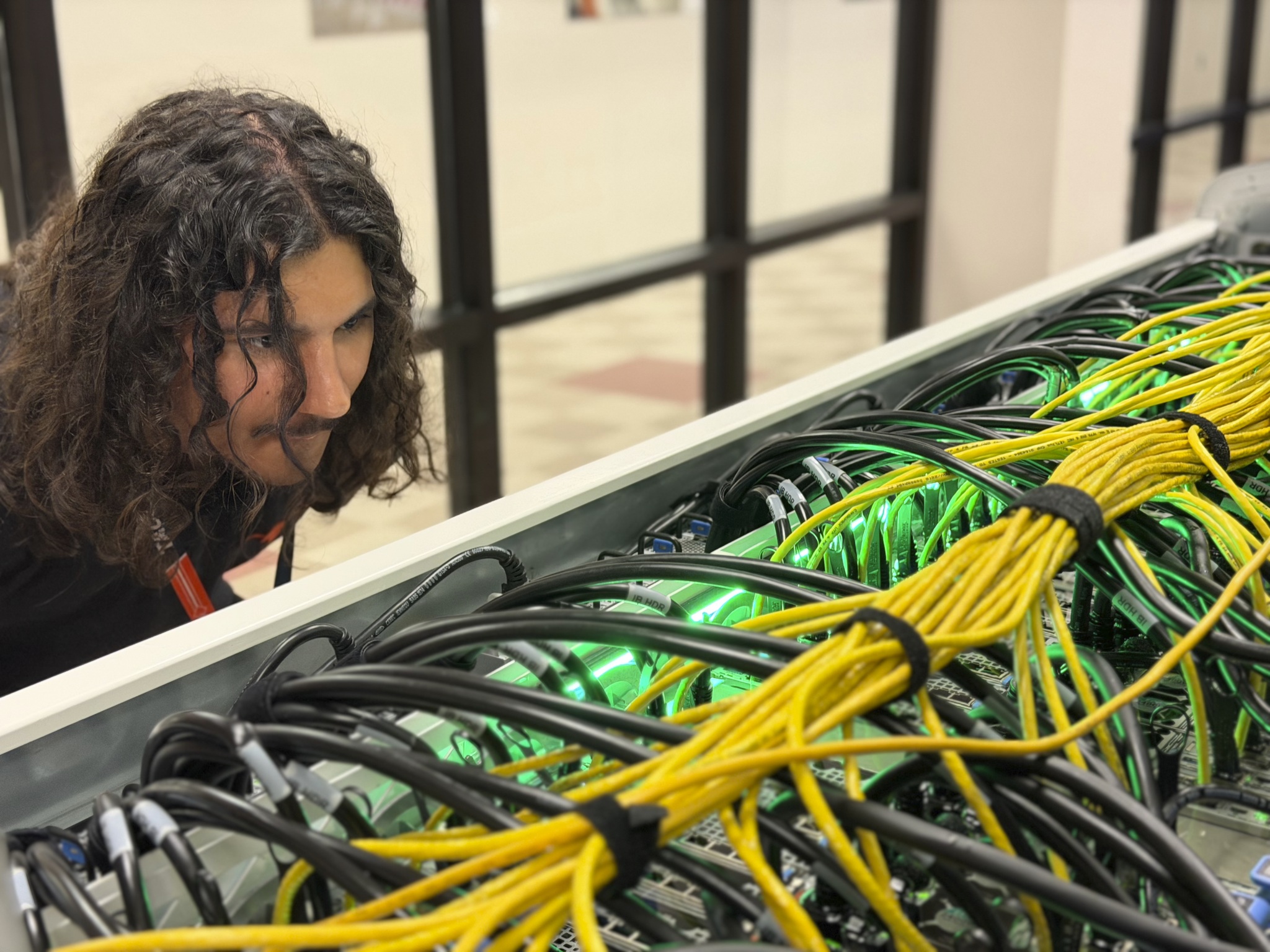
However, the Moncrief Internship is about more than just research – it’s also about relationships and building a shared foundation. Interns met with Oden faculty for a series of ‘lunch and learns’ that included Oden Institute Director Karen Willcox, as well as faculty members Jesse ChanHannah LuFeliciano Giustino, and Tom Yankeelov. Faculty shared their respective paths into research, paths that often were not clear cut and, much like research, involved life experiments that led them to where they are now. Interns also toured the Texas Advanced Computing Center (TACC) to see the machines behind the simulations they were running. The summer’s research culminated on August 6 in a poster session and reception where interns presented their final projects.
block.caption

Oden Institute Director Karen Willcox shares insights with this year’s Moncrief interns. Credit: Joanne Foote.

For two of this year's interns, Tomas Gutierrez and Dara Cheng, that shift—from being a student who receives knowledge to a researcher who creates it—defined their ten weeks at Oden. 

Tomas Gutierrez is a senior at UT studying mathematics. He is drawn to both sides of the discipline. “I love the theoretical side, understanding why ideas work, but I also enjoy applying those ideas to solve real-world problems,” he said. “That is one of the reasons I was excited about the Moncrief internship. It combined mathematics, scientific computing, and machine learning, which are all areas I am interested in.” 

Working with Tan Bui-Thanh, professor of aerospace engineering and engineering mechanics and co-director of the Center for Scientific Machine Learning, and Cole Nockolds, a CSEM graduate student in Bui-Thanh's research group, Gutierrez spent the summer building a foundation model for conservation laws: the partial differential equations that describe how quantities like mass or energy move and evolve over time. 

Rather than training a model to solve one equation, the goal was to help it recognize patterns across many conservation-law problems so it could generalize to equations it had never seen. The hardest part was making sure the model respected conservation itself. “If mass leaves one location, it should not just disappear, it should move into a neighboring location,” Gutierrez said. His model learned those local transfers between neighboring cells, then used them to predict how an entire system evolved over time, producing predictions that were “not only accurate, but also physically meaningful.” 

block.caption

Moncrief intern Tomas Gutierrez touring the TACC. Credit: Joanne Foote.

Gutierrez had done research before, at the University of Rochester the previous summer, but Moncrief felt a bit different. “Instead of being handed a well-defined problem, I had to help figure out what questions were worth asking, what experiments were meaningful, and whether the results actually supported our conclusions. That was a very different way of thinking.” 

He credits Bui-Thanh and Nockolds with striking that balance. “They gave me enough direction to keep moving, but also gave me room to make decisions and take ownership of the project. Instead of giving me solutions, they often asked me to explain my assumptions and defend my choices.” 

Nockolds said he became a mentor because of how much he'd gained from older students during his own time as an undergraduate researcher. He met with Gutierrez twice a week but tried to stay hands-off. “Working with Tomas was great, he was very perceptive and caught on to ideas quickly,” Nockolds said. “I wanted to allow him to come to conclusions on his own rather than directly guiding him.” The turning point came the first time Gutierrez's code worked. “I saw Tomas really gain confidence once, after much struggle, his first code was finally working and he was able to reproduce results from an initial paper we were reading together.”

Mentoring changed Nockolds too. “I think being a mentor made me a much better science communicator. I realized that I needed to adjust my explanations based on my mentee's current level of understanding.” Looking back across his own experience as both mentee and mentor, he sees the exchange as essential to how researchers are made. 

Beyond the technical skills I learned ... I also found it especially valuable to learn how my mentor conceptualizes and approaches research problems.

— Dara Cheng

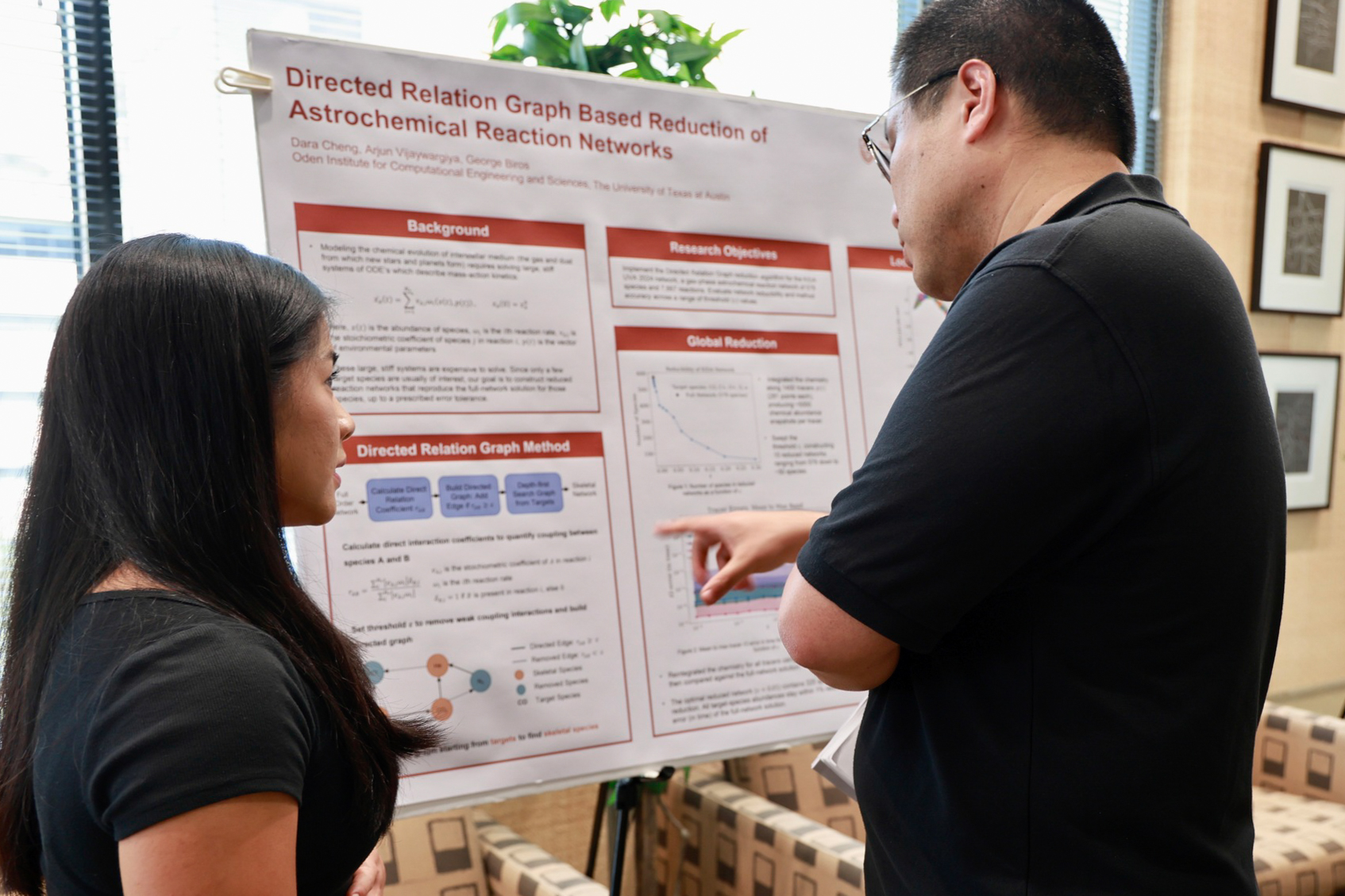
Dara Cheng, a rising senior at UT double-majoring in chemistry and mathematics, spent her summer on a very different kind of problem: modeling the chemical evolution of the interstellar medium, the gas and dust from which stars and planets form. Simulating those astrochemical reaction networks means solving enormous systems of ordinary differential equations, some involving roughly 500 chemical species. Cheng's project used a Directed Relation Graph method to shrink those networks down while preserving their accuracy.

The field itself was new to her. Cheng's previous research was in electroanalytical chemistry, so Moncrief was a chance to branch out. She worked under George Biros, professor of mechanical engineering and director of the Parallel Algorithms for Data Analysis and Simulation Group, and mentor Arjun Vijaywargiya, an O'Donnell Postdoctoral Fellow at the Institute. 

“My mentor really helped me in navigating a new field and developing new skills,” Cheng said. “Beyond the technical skills I learned from him, I also found it especially valuable to learn how he conceptualizes and approaches research problems.” The summer asked her to build fluency fast, and she came away seeing the work itself as the reward. “It gave me a better understanding of what it means to be a researcher and gave me more confidence to explore different areas.” 

Vijaywargiya, who has been mentored across many internships of his own, said the program gave him a chance to pass that forward. His approach with Cheng was to set the frame and let her fill it in. “I gave Dara a skeleton plan and encouraged her to explore around it,” he said. “That framework gave her the freedom to make the project her own, while keeping us on track to deliver something meaningful within the span of the internship.” Her breakthrough came early. After he asked her to read a handful of papers, she showed up to their next meeting at the whiteboard, walking him through the core algorithmic ideas in her own words. “That was the moment I knew she'd genuinely grasped the material and was ready to implement those algorithms at scale.” 

block.caption

Dara Cheng explaining her research at the final poster session. Credit: Joanne Foote.

By the poster session, Vijaywargiya said, watching her take the project to the finish line was the best part of the summer. “The most rewarding part was seeing Dara carry the project all the way through and present it on her poster,” he said. “She completed everything we set out to do, the poster turned out beautifully, and watching others stop to engage with her work made me proud. It was proof that her research mattered.” Cheng is staying on through the fall semester, and Vijaywargiya said her progress this summer opened up new directions they now plan to pursue together.

Mentorship is turning ‘figure it out alone’ into ‘let me show you what I learned.'"

— Arjun Vijaywargiya

That, more than any single result on a poster, is what the Moncrief Internship is built to do. Take students who are good at being students and give them ten weeks inside an active research group, ambiguity and all, to find out what it feels like to be a researcher.

More information about the Moncrief Undergraduate Summer Internship Program, including application deadlines, is available here.