University of Texas at Austin

News

Annual Workshop Brings Together Experts at the Intersection of Machine Learning and Scientific Computation

By Olivia Castillo, Tai Cerulli

Published Dec. 2, 2025

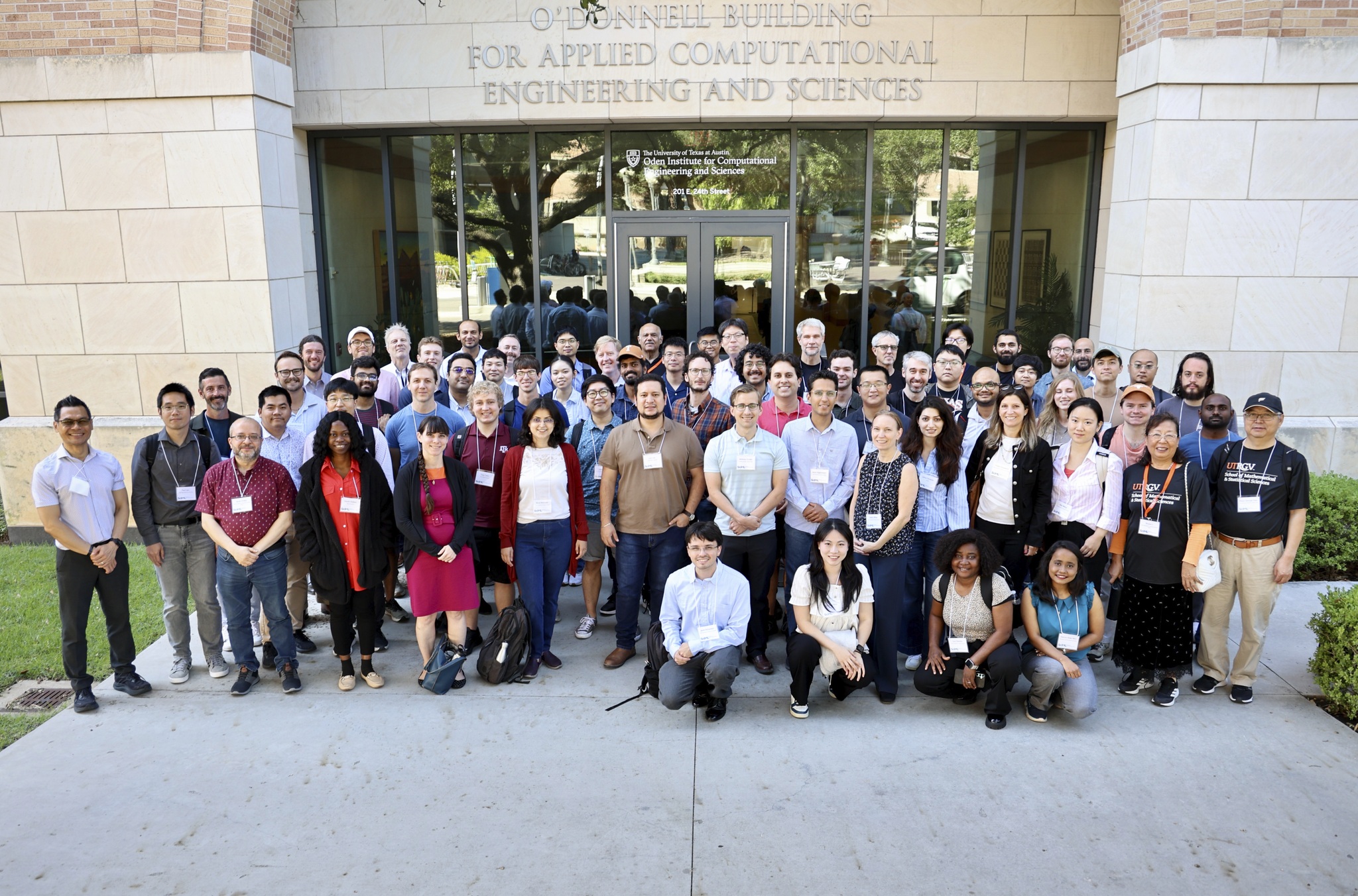
Participants at the 2025 Scientific Machine Learning Workshop. Credit: Joanne Foote.

The 2025 Scientific Machine Learning Workshop (SciML), hosted annually by the Oden Institute for Computational Engineering and Sciences at The University of Texas at Austin, brought together researchers, students, and industry collaborators for two days of talks and poster sessions that were focused on AI-powered approaches to complex scientific problems. This year’s event, held on Sept. 25 - 26, centered around a focused theme: Scientific Machine Learning for Differential Equations. 

According to event organizer Tan Bui-Thanh, professor of aerospace engineering and engineering mechanics and head of the Probabilistic and High Order Inference, Computation, Estimation, and Simulation Group at the Oden Institute, the decision to narrow the scope of the third annual conference led to “a great sample of the community coming together to exchange ideas and learn from each other.” With attendees ranging from applied mathematicians to engineers from around the world as well as national lab scientists, the event fostered an environment for deep conversation around theory and computation, as well as real-world applications of machine learning in scientific domains.

“This year’s theme really resonated with a large number of registrants and resulted in strong attendance through the final talk,” Bui-Thanh noted.

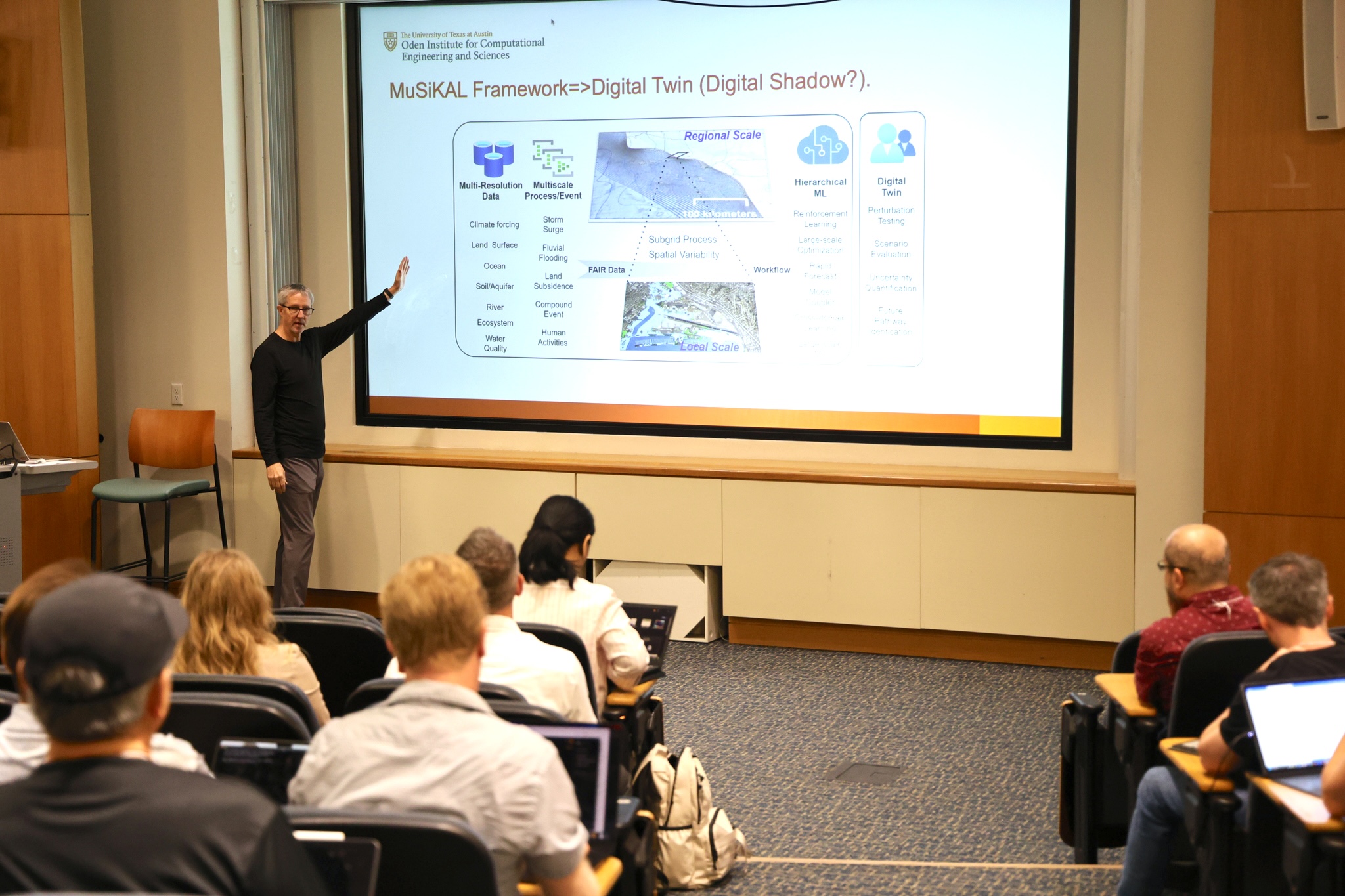
UT’s Clint Dawson was among the more than 17 presentations over the two-day workshop. Dawson’s talk on coastal storm surge modeling demonstrated how machine learning algorithms are being used in practical applications. Dawson, professor of aerospace engineering and engineering mechanics and head of the Computational Hydraulics Group at the Oden Institute, said his research team is developing a dynamic digital twin of the coastline. This model would continuously adapt to real-time data, offering a powerful tool for predicting and responding to coastal hazards in areas where a significant portion of the U.S. population resides that are especially vulnerable to tropical systems.
block.caption

Professor Clint Dawson giving his talk on coastal storm surge modeling. Credit: Joanne Foote.

Professor Moriba Jah gave a fast-paced talk about conventional Bayesian approaches to inference. Jah is a professor of aerospace engineering and engineering mechanics and lead of the Jah Decision Intelligence Group at the Oden Institute. During his talk, he introduced the Epistemic Support-Point Filter, a model that works not by predicting what is true, but by instead systemically removing what isn’t. “I’m not here to force the data to tell me something,” Jah said. “I want it to tell me what the wrong answer is.”

The first day’s events concluded with a poster session highlighting early-career scientists. Oden Institute graduate research assistant Wesley Lao presented a method for combining fast, low-resolution models with slower, high-accuracy simulations. This is especially useful for fields such as fluid dynamics or nuclear modeling, where computations can take days.

UT undergraduate student Mayank Konduri from the Cockrell School of Engineering showcased a method of visualization that helps demystify how Rectified Linear Unit (ReLU) neural networks transform data through their layers. “Everyone just trusts the output,” he said. “But I wanted to understand what’s actually going on inside," said Kondrui. ReLU functions, which output zero for negative inputs and a linear value for positive ones, are among the most common activation mechanisms in machine learning, allowing neural networks to model complex and non-linear patterns. 

Additional sessions explored everything from predicting surface ocean carbon to improving rocket combustor efficiency. In its third year, the SciML Workshop continues to gain momentum providing a platform for cutting-edge research and deep interdisciplinary exchange. Reflecting on the broader goals of the event, Bui-Thanh noted that SciML is heading toward large-scale, real-time modeling for impactful scientific domains. “Foundational models for sciences and the development of a real-time SciML model for real applications of importance to sciences, engineering, and society is where we are seeing the field go.”

The workshop was co-organized by Bui-Thanh and Ph.D. student Krishnanunni C.G., as well as Oden Institute faculty member Stella Offner, co-director of the Center for Scientific Machine Learning, reflecting the event’s cross-institutional collaboration and technical breadth. The organizing team received essential administrative support from Karen Rumpf, whose coordination helped bring the two-day workshop together. The team is grateful for the support of Oden Institute leadership.