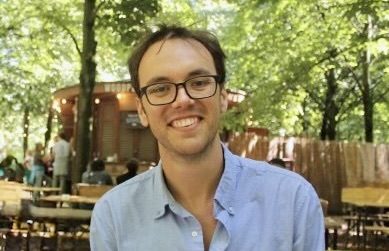
What drew you to this area of research?
I’m originally from Texas and left to study physics, engineering, and computer science at Washington University in St. Louis. It was there that I took an undergraduate elective course titled “Physics of the Brain.” The class was a blend of understanding the computational ingredients of artificial intelligence and how the brain is implementing similar algorithms. I got very excited about trying to understand how the brain learns and stores memories, and how to build algorithms inspired by those processes to accomplish real-world tasks like computer vision or language processing. This course was the gateway that led me to pursue my Ph.D. in applied mathematics at Harvard University. After graduating, I stayed for a year of postdoctoral research in theoretical neuroscience at the Harvard Center for Mathematical Sciences and Applications.
Tell us about your research and why it’s impactful.
Broadly, I study how neurons are connected in the brain and how these connections evolve as the system learns new things. This includes examining the rules of these neural networks and their behavior as they scale in size, noting that bigger brains and bigger AI models both tend to perform better. My research focuses on whether these growing networks converge to a well-defined limit, using tools from random matrix theory and high-dimensional probability. I also investigate fundamental questions about memory: how many memories a network can store, how robust their retrieval is, and how they degrade using precise mathematical modeling.
What are some potential real-world applications of your work?
My hope is that this research will serve to help shape neuroscientists’ understanding of the brain while enabling computer scientists to build more efficient AI. For example, my research about neural networks converging to a well-defined limit will allow AI companies to scale up small models without having to retune everything from scratch, potentially saving millions of dollars.
What makes your research unique?
Though my research leans more towards neuroscience and applied mathematics, I enjoy the physicist’s love for simplicity. Rather than trying to track every minute detail of an enormous neural network, I search for the underlying laws that govern its macroscopic behavior. What makes my research unique is that I have a physicist’s interest in identifying tractable but descriptive limits of the system that let you make precise statements about it. For example, in thermodynamics, instead of tracking every individual particle of gas, physicists describe their behavior with macroscopic descriptions like temperature, pressure, and volume. Similarly, I am looking for collective properties of large-scale neural networks: what are the summary statistics that describe the behavior of the entire network? And what is the ideal gas law for the brain?
What drew you to the Oden Institute?
Leveraging computational science, engineering, and mathematics to make progress on fundamental technologies is what makes the Oden Institute so unique — collaboration to understand a variety of socially valuable problems. Being in a place that brings together high-quality researchers and students, the interdisciplinary research environment, and the compute resources at the Texas Advanced Computing Center (TACC) is a truly special combination. I am excited to work with students and create a welcoming environment that encourages discussion and collaboration. As a bonus to being back in Texas, and especially Austin, is that I get to explore this cool city.
Professor Bordelon will be spending the academic year working as a research scientist at Cursor. He will join us on campus in August 2027.