University of Texas at Austin

News

David Fridovich-Keil Receives O’Donnell Distinguished Research Award

Published April 24, 2026

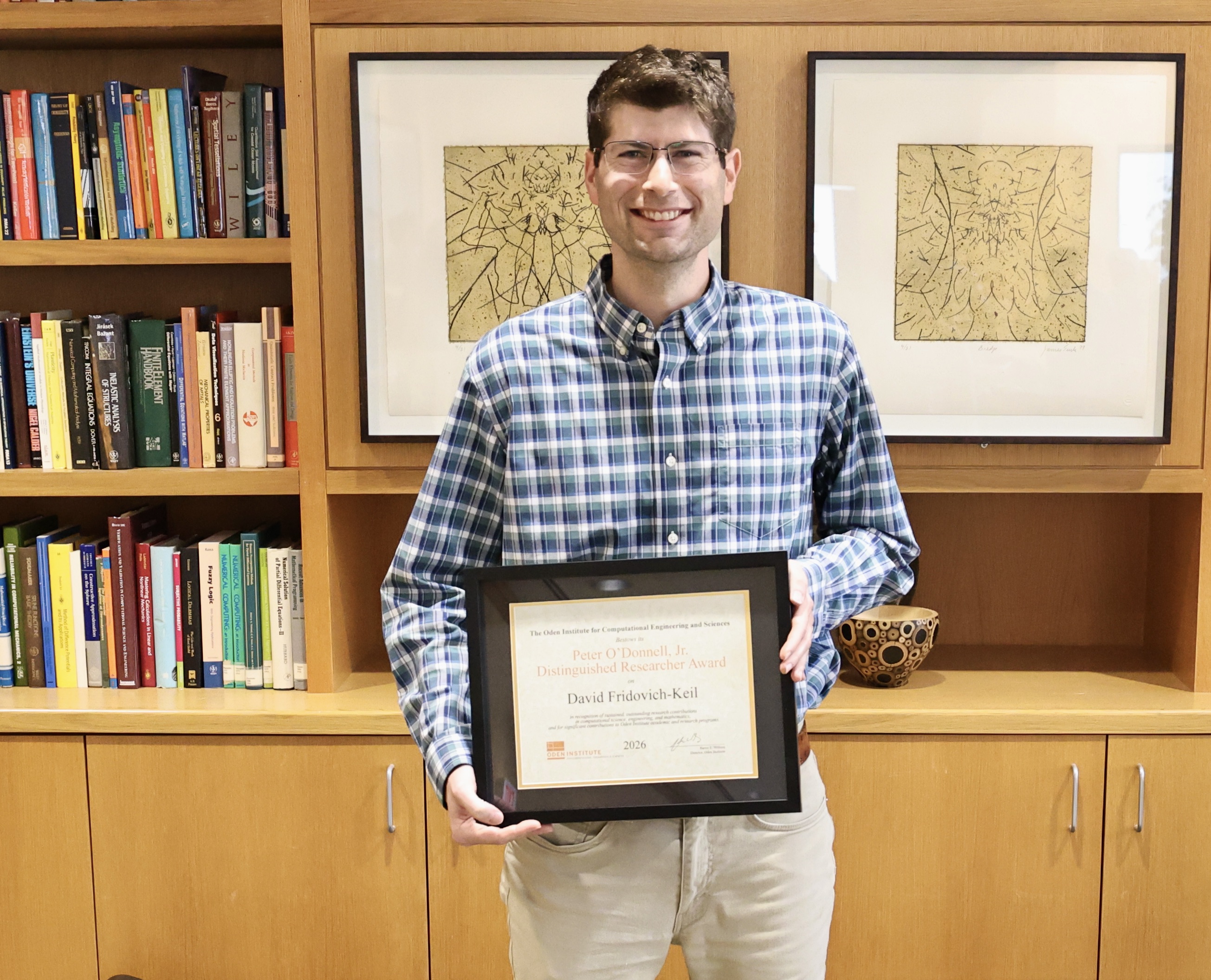
Dr. Fridovich-Keil being presented with the Peter O'Donnell Distinguished Researcher Award. Credit: Joanne Foote

David Fridovich-Keil, a core faculty member of the Oden Institute for Computational Engineering and Sciences and assistant professor in the Department of Aerospace Engineering and Engineering Mechanics has been named the 2026 recipient of the Peter O’Donnell, Jr. Distinguished Research Award.

“I was surprised. I actually had no idea that I had even been nominated,” Fridovich-Keil said. “But I was obviously thrilled to get it.”

The award recognizes outstanding and innovative research in computational science and engineering. For Fridovich-Keil, whose work spans robotics, control theory, and game theory, the recognition reflects the growing relevance of a field that has long operated in a relatively small corner of other, larger fields.
“Game theory is a little niche,” he said, noting that it connects to a wide range of real-world systems.

A member of the Oden Institute’s Center for Autonomy, Fridovich-Keil’s research focuses on how autonomous systems, such as robots or vehicles, make decisions in environments shaped by the actions of others. Much of his work centers on multi-agent systems, where multiple decision-makers interact over time, each responding to the behavior of those around them.


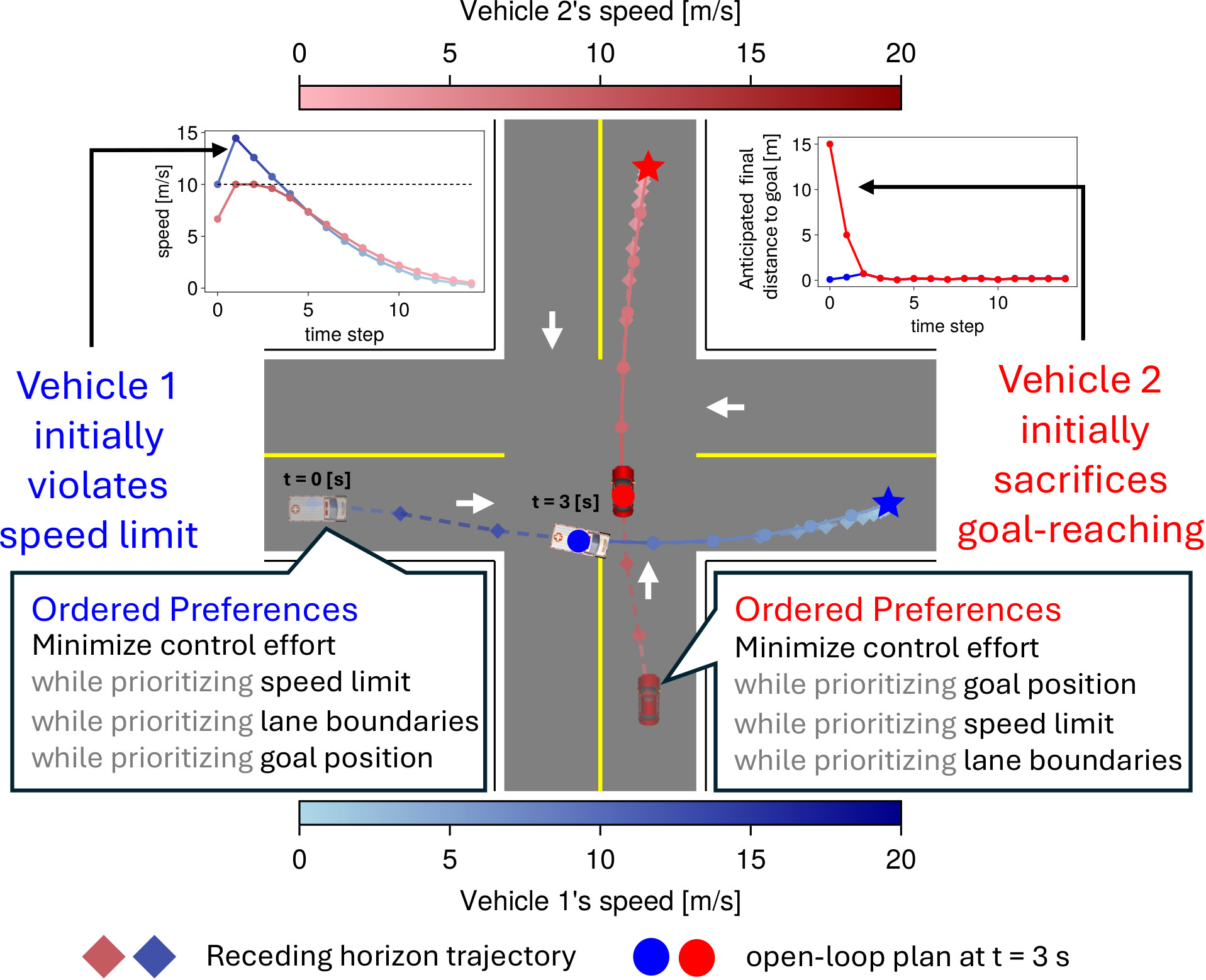
block.caption

A two-vehicle intersection scenario showing how autonomous systems balance competing priorities, such as speed, safety, and reaching a goal. Each vehicle adjusts its behavior based on these priorities, sometimes sacrificing one objective to satisfy a more important one. Credit: Dr. Fridovich-Keil

Broadly, his research seeks to compute solutions to these games — mathematical models that describe how rational agents behave when their goals and constraints are intertwined. As he put it, the goal is to “compute solutions to games, which describe what decision-makers should rationally wish to do.”

This line of work often involves balancing competing priorities, such as safety and efficiency, in complex systems. In settings like driverless cars, systems must prioritize critical constraints, like avoiding collisions, while still following secondary goals such as speed. Instead of treating all objectives equally, Fridovich-Keil’s research explores how structured hierarchies of preferences can guide decision-making in a more reliable way.

His path began during a graduate internship at a self-driving vehicle company, Nuro, where he worked on predicting how other drivers would behave and planning responses accordingly. What began as an office joke — that predicting a vehicle’s own behavior would eliminate the need for planning — eventually led to a deeper realization: predicting others’ behavior and planning one’s own actions are fundamentally linked when each participant is making decisions. “I realized we need to be solving games to do this,” he said.

Think about settings like driving in traffic. Everybody’s making decisions, and because those decisions affect others… that gives rise to what’s called a dynamic game.

— Dr. Fridovich-Keil

That realization shaped the direction of his doctoral work. A pivotal moment came soon after, when a conversation with mentor Andy Packard helped refine his ideas. “We talked probably for at least two hours, and that conversation basically set me on the technical direction I’ve been on ever since,” Fridovich-Keil said.

While his early research was closely tied to autonomous vehicles, he now sees broader applications for these ideas, and he has shifted his attention to other domains where decision-making under uncertain conditions plays a central role. One such area is the energy sector, where decisions about energy generation and consumption affect grid reliability. He’s also looking at supply chains and financial systems, where hierarchical decision structures shape outcomes across entire networks.

A central challenge in this work lies in dealing with incomplete information, or situations where agents must act without fully knowing others’ goals or constraints. “I’m interacting with somebody, but I don’t know exactly what they want,” he explained. “That makes it very difficult to figure out the right behavior.”

The Distinguished Research Award not only recognizes Fridovich-Keil’s contributions but also provides research support that will help expand his group’s work. He explained that the award funding fills important gaps, allowing him to support a broader range of students and research activities.

Fridovich-Keil also emphasized the role of mentorship and collaboration in shaping his work, crediting his Ph.D. advisor Claire Tomlin, mentors Andy Packard and Mac Schwager, and the students in his research group. “None of this would happen without their hard work and dedication,” he said.

As his research continues to evolve, Fridovich-Keil remains focused on expanding the reach of these ideas to increasingly complex systems. At its core, his work asks a simple but far-reaching question: how do we make good decisions when those decisions depend on everyone else?