Hughes echoes that assessment. “Derya is a talented and focused researcher, and CSEM student,” he said. “She has demonstrated perspicacity and determination in her glymphatic system research and has already obtained very important results. I predict she will make significant contributions to the understanding of neurodegenerative disease.”
The environment at the Oden Institute has reshaped how she approaches problems. Before arriving, she had little experience working across disciplines. Now she collaborates with imaging specialists, biologists, and clinicians.. "I approach problems differently," she said, "I now know experts in their own fields, and have an idea of how to work with them." One recent moment crystallized this shift: shortly after attending a workshop on the glymphatic system, she had a realization that two systems she had long regarded as separate were in fact connected. "If we could find and model that connection, we would be solving one of the biggest questions in the field," she said. "That is really exciting for me."
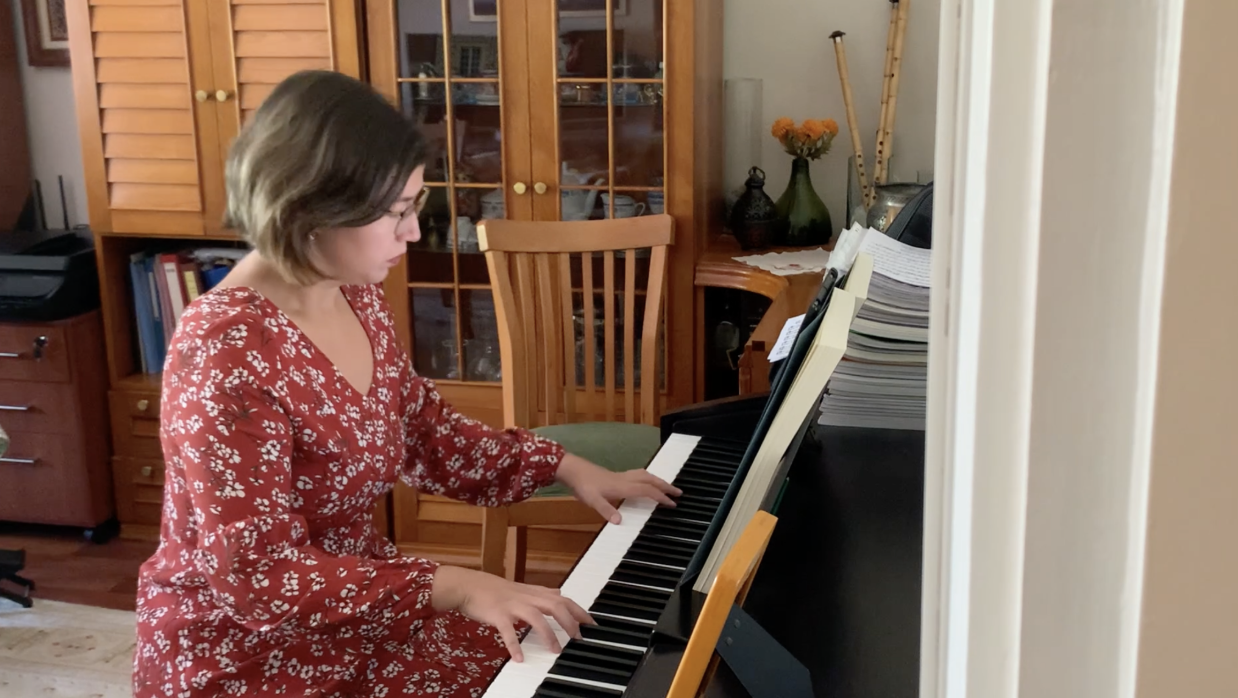
An accomplished pianist, Derya has played since she was five years old, and she sees a direct line between practicing an instrument and conducting research. "Having to sit down, practice the same passages, learning new techniques, and having slow, incremental progress that requires time, effort, and patience is similar to how I see research," she said. "Playing the piano puts me in the right mindset." She also pursues watercolors and crochet, and volunteers as an instructor through the Texas Prison Education Initiative, teaching college-level mathematics to inmates at the Coleman Women's Correctional Facility in Lockhart. "I always leave with a newfound love of teaching and learning, and inspired by strong, smart women."
She is quick to note that she took what she calls "the scenic route," completing a full master's degree in Turkey before applying to Ph.D. programs, arriving in Austin with more research experience, more published work, and a clearer sense of what she wanted to do. "I realize that may not work for everybody but it worked out really well for me." The trajectory has not gone unnoticed. Bakiler recently received the Outstanding Graduate Research Fellowship from the UT Graduate School, which will fund her continued research at the Oden Institute.
The long-term vision for her research is ambitious. Within five years, Derya hopes to have a pipeline that takes a patient's brain MRI as input and produces long-term plaque formation predictions as output, eventually without relying on invasive experimental procedures. In the ten-year view, she sees patient-specific computational models like hers becoming a genuine part of clinical practice, shifting medicine toward prevention rather than treatment. "I truly believe that digital twins will be the next big revolution in healthcare," she said, "and will change how we approach many diseases that we currently do not have a cure for, like Alzheimer's disease."