University of Texas at Austin

Profile

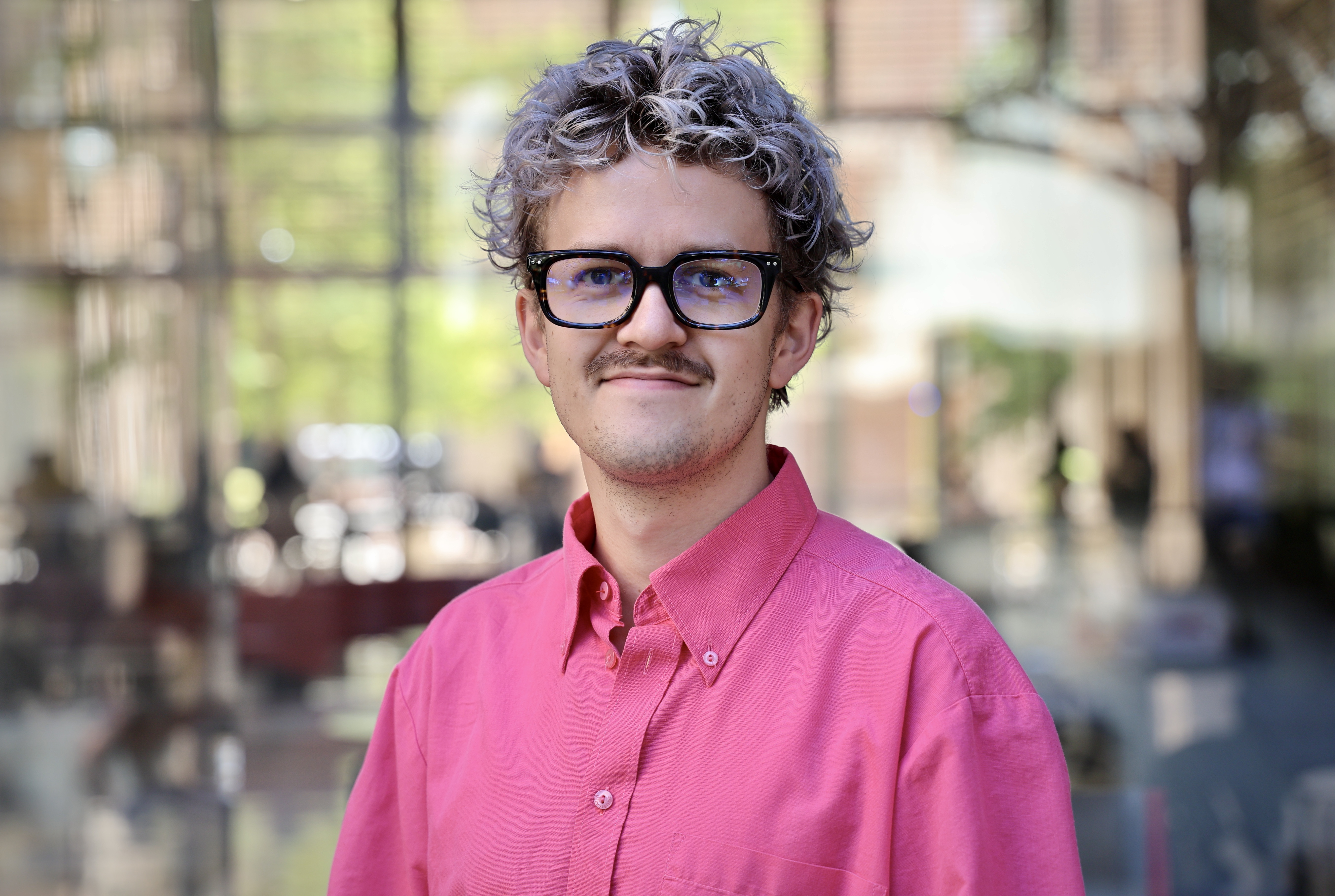
Finding Structure in the Noise - Profile Paul Beckman

Published Sept. 17, 2026

Paul Beckman. Credit: Joanne Foote.

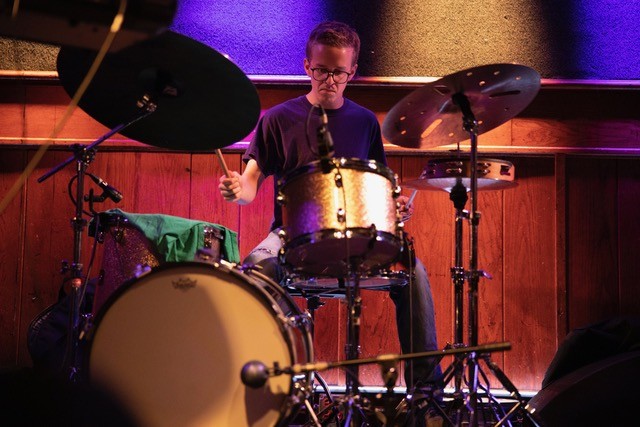
Paul Beckman spent much of his early life balancing two disciplines: music and mathematics. He began playing drums at age nine, and when it came time to apply to college, he leaned toward conservatories and music schools, intending to write and perform professionally. However, that changed once he arrived at the University of Chicago and began to see how wide the world of mathematics was.

This shift carried him to a Ph.D. in mathematics at the Courant Institute of Mathematical Sciences at New York University, and now to the Oden Institute for Computational Engineering and Sciences, where he is a second year Peter O'Donnell Jr. Postdoctoral Fellow, working with Joe Kileel, associate professor of mathematics, and Per-Gunnar Martinsson, professor of mathematics, in the Center for Numerical Analysis.

"Math research offered so many new ways of thinking and understanding and I wanted to learn the tools that would let me participate in that ever-evolving shared knowledge,” said Beckman.
Beckman's research focuses on finding and leveraging simple, local structure hidden inside large, complex data, particularly matrices and tensors. That data might describe interactions between charged particles, relationships between pixels in a set of images, "or anything in between," he said. By identifying properties these different types of data have in common, such as smoothness or sparsity, Beckman builds computational methods that make it possible to compress and understand them far more efficiently.

One of the more persistent open problems in the field, he says, involves highly oscillatory operators, like those that describe high-frequency acoustic scattering or turbulent fluid flow. Beckman explains the distinction in musical terms: the slow, steady vibration of an upright bass string behaves very differently, computationally, than the high-pitched crash of a cymbal bouncing around a room. “Both of these examples have rich local structure but it's a fundamentally different kind of structure than the low-rank patterns researchers typically exploit in non-oscillatory problems,” he explained. Developing methods that can take advantage of the oscillatory kind, he says, "remains an exciting area with many open questions."

This efficiency does not stay contained to one field. Methods for compressing hierarchical low-rank matrices and tensors have already sped up electromagnetic scattering problems in medical imaging, as well as stochastic models used to track ocean currents; two fields with little in common beyond the mathematical structure underneath them.

"This is the beauty and benefit of mathematical abstraction," Beckman said. "Methods built on a particular underlying mathematical structure can lead to benefits across disparate applications where this structure is found."

What drew Beckman to the Oden Institute was its active, interdisciplinary research community. "The faculty and students here work on a variety of problems that connect mathematical theory to a wide array of applications," he said. "That breadth and interconnection was exactly what I was looking for as a postdoc."

That's played out directly in his collaboration with Kileel, whose toolbox leans on abstract algebra, a contrast to Beckman's own analysis-based background. The two share an interest in using underlying structure to enable efficient computation for statistics and data science, which has given Beckman room to learn an unfamiliar set of ideas: "It's given me the opportunity to learn about and incorporate a set of ideas from a different subfield, to use a different lens to look at the same problems."

Looking ahead, Beckman hopes to carry that same approach into his own research program. His central interest lies in spatial statistics: using structure in matrices and tensors to speed up probabilistic models of environmental data, like sea surface temperature or wind velocity. As a postdoc, he's treating the fellowship as a chance to gather tools before applying them there, particularly ideas drawn from Martinsson's work on randomized numerical linear algebra and Kileel's research on tensor factorizations.

Beckman traces his approach to collaborative research back to his years in music, and compares working as part of a research group to playing in a band or an orchestra: "When you're a high school or college student learning math, you don't necessarily see that it's a collaborative activity," he said. "But research certainly is. Everyone brings their own ideas, and progress depends on constantly listening to, understanding, and responding to other people's interpretations to reach a result that holds together.”

The way I approach the process of listening to and synthesizing ideas collaboratively in scientific research is similar to the way I approach making music.

— Paul Beckman

Since arriving in Austin, Beckman has been finding new swimming holes to escape the summer heat, eating his way through the city's barbecue, and getting acquainted with the local music scene. "You can often find me listening or playing at a local venue," he said, "whether it's a punk show, a singer-songwriter open mic, or a jazz club jam session."

Asked what advice he'd give to someone considering a similar path into research, Beckman answers: "Your passion for your field of study is precious, so follow your interests. The pace and rigor of academia can be demanding, so that fundamental, underlying passion for your research area is an essential source of motivation."

block.caption

Paul playing the drums. Credit: Paul Beckman.