University of Texas at Austin

News

Oden Institute Announces Inaugural Kay Bailey Hutchison Computational Energy Fellows

Published April 9, 2026

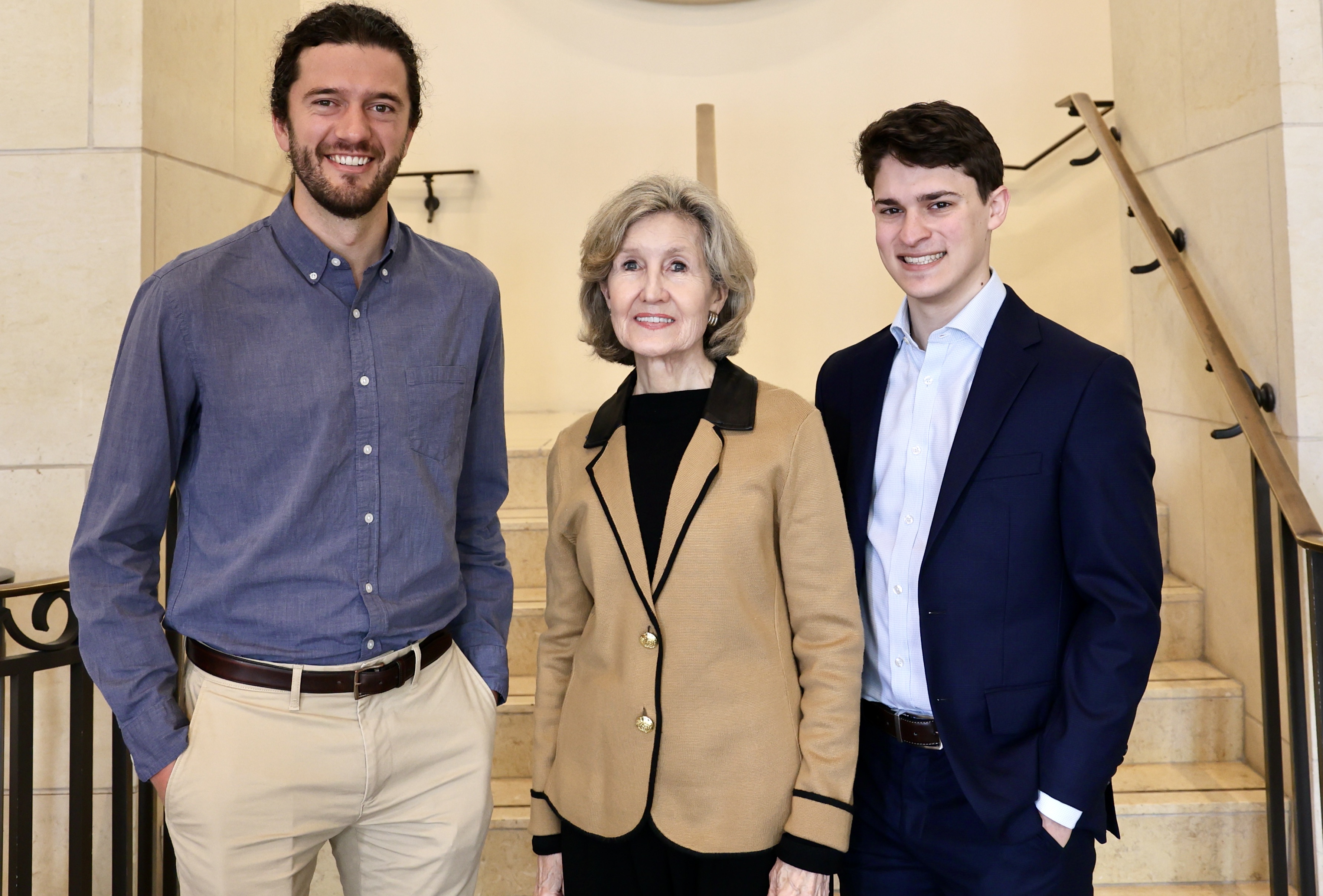
L-r: Benjamin (Ben) Zastrow, Sen. Kay Bailey Hutchison, Braden Pecora. Credit: Joanne Foote

The Oden Institute for Computational Engineering and Sciences and the Kay Bailey Hutchison (KBH) Energy Center have announced the inaugural recipients of the KBH Computational Energy Fellowship. The program, announced last fall, is designed to bridge cutting-edge computational science with real-world energy challenges. The KBH Fellowship at The University of Texas at Austin will prepare students to apply computational methods across the full spectrum of energy sources and technologies represented at the KBH Center.

The 2026-27 fellows, Braden Pecora and Benjamin Zastrow, bring expertise in high-performance computing, artificial intelligence, and physics-based modeling to some of the most pressing problems in the energy sector.

Braden Pecora

Braden Pecora, a graduate researcher in mechanical engineering at the Cockrell School of Engineering, works with Kevin Clarno, affiliated faculty at the Oden Institute and associate professor of mechanical engineering. His research focuses on advanced nuclear systems and large-scale energy infrastructure. Pecora’s path into the field was shaped by a defining moment: when the 2021 winter storm knocked out Texas's power grid. He saw firsthand how vulnerable the state's infrastructure could be. "I wanted to use my computational skills to actually help fix it," he said.

That motivation led him toward nuclear systems, where he  builds complex multiphysics simulations of molten salt reactors, a next-generation design that has attracted renewed interest for its safety and efficiency potential. Unlike conventional reactors, molten salt reactors use liquid fuel that flows continuously, making their physical behavior unusually difficult to model. "Because the fuel is a flowing liquid, the fission process happens within a continuously moving stream," Pecora explained. "My research focuses on building models to predict exactly how these reactors will behave."

His work also extends to the infrastructure scale. During his undergraduate research, Pecora developed models for nationwide hydrogen infrastructure planning – experience that now informs how he thinks about the broader energy system. High-performance computing runs through all of it. "Without massive computational power, we would be forced to rely on overly simplified models that miss the complex physical realities of advanced nuclear systems,"  said Pecora. Through the KBH Fellowship, Pecora hopes to bridge the gap between that technical work, the policymakers and public audiences who need to understand it.

I hope to bridge the gap between technical work, the policymakers and public audiences who need to understand it.

— Braden Pecora

Benjamin Zastrow

Benjamin Zastrow, a graduate researcher working with Professor Karen Willcox, director of the Oden Institute, focuses on digital twins, reduced-order modeling, and uncertainty quantification. His research develops computational tools that are both fast enough and reliable enough to support real-time decision-making in large-scale energy systems.

Zastrow sees digital twins as one of the most impactful ways computational science connects directly to real-world energy systems. Drawing on his research with TotalEnergies on wind farm energy forecasting, and earlier work on nuclear reactor control systems at Idaho National Laboratory, he studies how virtual models can mirror and improve physical energy infrastructure. “Digital twins allow us to make accurate predictions and decisions about a system in real time,” he said. “Every turbine in a wind farm might get its own digital twin, allowing us to tailor the maintenance schedule, control algorithms, and energy yield predictions to the specific conditions experienced by that specific turbine.”

To enable this kind of real-time insight, Zastrow develops methods that make complex simulations faster and more reliable. “Reduced-order models can accelerate expensive predictions, from taking hours to taking just minutes or seconds, with only small losses in accuracy,” he explained. Paired with uncertainty quantification, these tools help engineers understand how much confidence to place in predictions when real-world conditions are uncertain.

His work sits at the convergence of traditional physics-based modeling and modern machine learning. Rather than choosing between the two approaches, Zastrow develops methods that combine them. “Scientific machine learning tries to get the best of both worlds by starting with the physics we already know and then augmenting that knowledge with AI where it is helpful,” he said.
Scientific machine learning tries to get the best of both worlds by starting with the physics we already know and then augmenting that knowledge with AI where it is helpful.

— Benjamin Zastrow

During the year-long KBH Fellowship, Pecora and Zastrow will mentor students, lead workshops, and contribute to programming within the KBH Energy Center, helping to translate cutting-edge computational research into practical tools for the energy challenges ahead.

About the Fellowship

The KBH Computational Energy Fellowship was established in 2026. Fellows will contribute their knowledge of computational science to the educational programming of the KBH Center’s Energy Studies Minor to  showcase the power of computational science through educational presentations, participation in mentoring and networking events, and content creation.