University of Texas at Austin

News

Rethinking How Molecules Move in Complex Cellular Environments

By Tai Cerulli

Published March 4, 2026

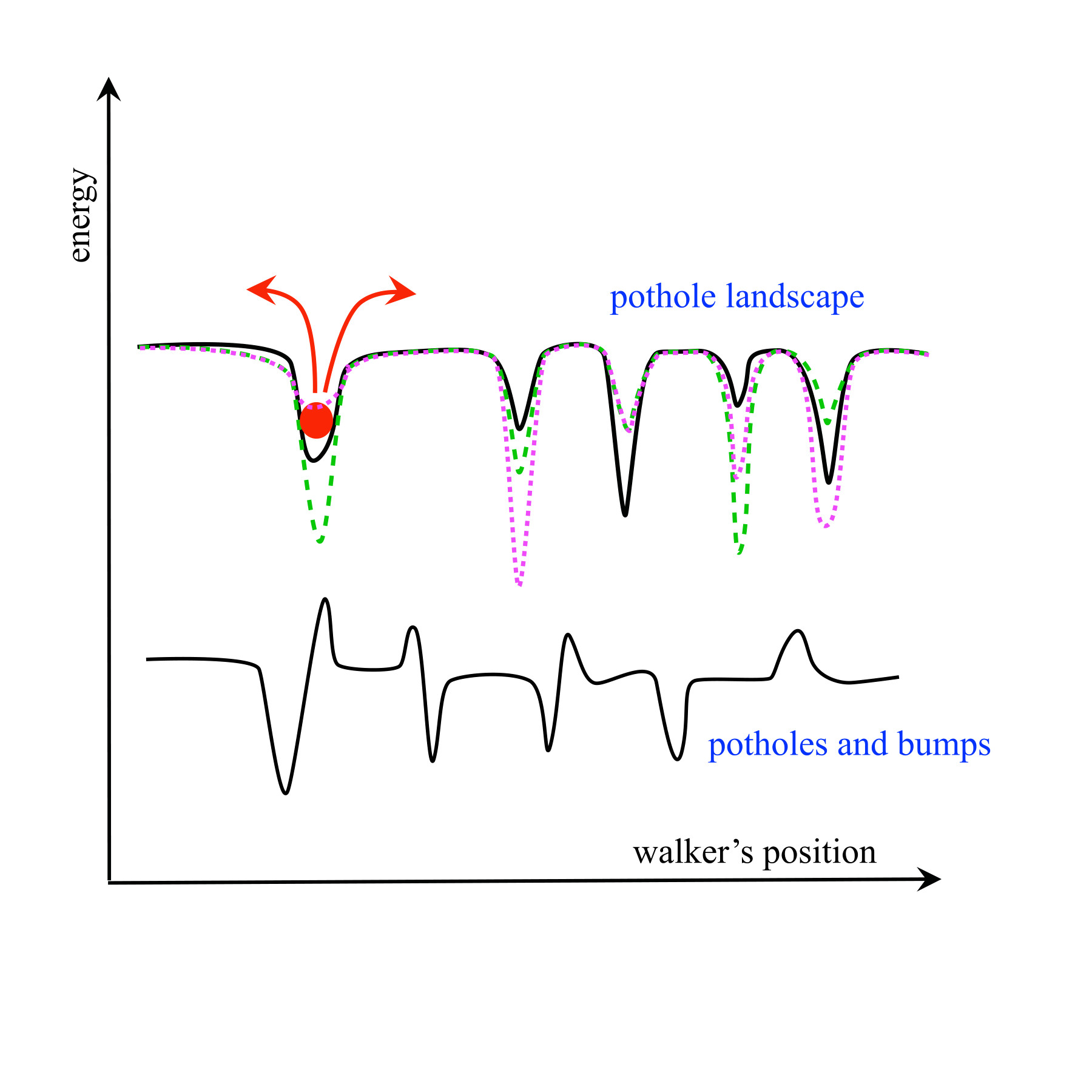
In the “pothole” landscape model, deep energy wells temporarily trap a diffusing molecule. When these wells fluctuate, the overall diffusion rate remains the same as in a frozen landscape - added energy “bumps” alter the motion. Credit: Dmitrii Makarov

Inside of a living cell, there is no such thing as moving through empty space. Molecules inside drift and collide, constantly feeling forces from everything around them, such as electric charges or nearby structures. In a basic liquid like water, scientists can describe the motion of such molecules surprisingly well using the theory of Brownian motion, which maintains that every microscopic detail about the liquid isn’t required for accurate predictions. Instead, only a few key properties are needed, such as temperature and viscosity. While this theory does work, a cell is more complex and unpredictable than water. So, this raises the question: can existing frameworks still be applied, or does a new framework need to be developed to explain how molecules move in environments like these?

This question sits at the heart of a new study by Dmitrii E. Makarov, core faculty member at the Oden Institute for Computational Engineering and Sciences, and a professor in the Department of Chemistry at The University of Texas at Austin and his co-author Peter Sollich, a professor of theoretical physics at the University of Göttingen in Germany. 

Their paper, “Static and Dynamic Rough Energy Landscapes Can Lead to Identical Diffusivity,” published in the Proceedings of the National Academy of Sciences, explores a counterintuitive idea: even if the “obstacles” slowing molecular movement in living cells fluctuate rapidly, motion may not get faster. In some cases, it actually slows down exactly as much as if nothing were fluctuating at all.

To explain the issue, Makarov offers a metaphor of potholes. Imagine walking on a road full of potholes, which represent certain “traps” in a rough environment. These potholes increase the likelihood of getting trapped instead of moving forward smoothly. 

In physics, that roughness is described as a “rough energy landscape,” which is a way of telling how some locations are energetically more favorable (or easy to fall into) and others are more difficult to cross (like barriers). On average, If the potholes are deep, more time and energy are spent climbing out, thus slowing progress down the road.

This idea was first formalized decades ago in a famously succinct paper by Robert Zwanzig. Zwanzig’s model demonstrates how to calculate the slowdown based on the roughness of the landscape. It has become, in Makarov’s words, “an absolutely beautiful paper… only three pages long, with the result derived in two lines.” That elegance, combined with its wide usage in single-molecule science, made it a natural starting point for revisiting how rough landscapes affect motion.

Yet, there is a large assumption that is buried in the pothole metaphor. In Zwanzig’s original framework, he takes a stance that the potholes do not move. Real cells, however, don’t have frozen landscapes. Their “potholes” are a result of other molecules that are always in motion. 

The resulting intuitive expectation seems straightforward. If potholes appear and then disappear quickly enough, constantly shifting locations, then shouldn’t it feel smoother? Think of it as driving fast over a bumpy road. The bumps should seem less noticeable, right?

Makarov originally wanted to prove that molecules can move even faster when the potholes are dynamic. Instead, he discovered the complete opposite.

The turning point for the research came after conversations with longtime collaborator Ben Schuler, a professor of molecular biophysics at the University of Zurich in Switzerland, who studies dense protein environments where molecules move anomalously slowly. The work by the Schuler group suggested a highly dynamic – and therefore effectively smooth – landscape experienced by a charged molecule in a biomolecular condensate.

After the discussions, Makarov decided to test the intuition himself. While traveling by train, he sketched out a simple “toy model” in which a particle performs a random walk on a lattice, with each site switching between different states: shallow traps, deep ones, or no trap at all. The goal was to see whether rapidly fluctuating traps would indeed make motion faster.

What he and Sollich found was not at all what he expected. “To our big surprise, that turns out to be not true.” Even when the traps fluctuated rapidly, the particle’s average rate of diffusion still remained the same, exactly as in the case where the landscape was frozen in time. 

At first glance, this finding may seem illogical. The key insight, Makarov explains, lies in the idea of mutual interaction. A particle does not only move through a passive background. Instead, as it moves, it also influences that same background. 

When you interact with the landscape, you change the landscape itself.

— Dmitrii Makarov

To get the full picture, he offers another metaphor. Imagine walking through a crowd where each person is either fully distracted by their phone or open to conversation if you bump into them. If someone is distracted, you can quickly pass by. If they are friendly, they will stop and engage, slowing you down. 

The key takeaway is that the interaction works both ways. Once someone starts talking, social convention will keep them in that state longer. In other words, when they slow you down, you’re also slowing them down. Therefore, the environment and the particle are linked.

In the physics world, this reciprocity is required by a principle known as detailed balance, which governs systems in equilibrium. If a fluctuating pothole could simply eject a trapped particle without consequence, then it would be injecting energy into the system. This would violate the assumption that the system is not being externally powered. When a model properly accounts for this mutual interaction, Makarov and Sollich’s surprising result follows: dynamic landscapes do not automatically lead to faster diffusions.

For experimental scientists studying single molecules, this finding carries significant weight. Zwanzig’s model, used to interpret unexpectedly slow motion, is not fundamentally wrong, even in environments where conditions fluctuate. However, Makarov’s research suggests that such models may simply be underestimating how rough those particular environments truly are.

The work was supported by the National Science Foundation under Grant No. CHE-2400424. Makarov also acknowledges support from the Alexander von Humboldt Foundation through a Humboldt Research Award, which enabled his extended stay in Germany and collaboration with Peter Sollich.