University of Texas at Austin

News

Stefan Henneking on the Gordon Bell Prize and the Future of Tsunami Early Warning

Published May 7, 2026

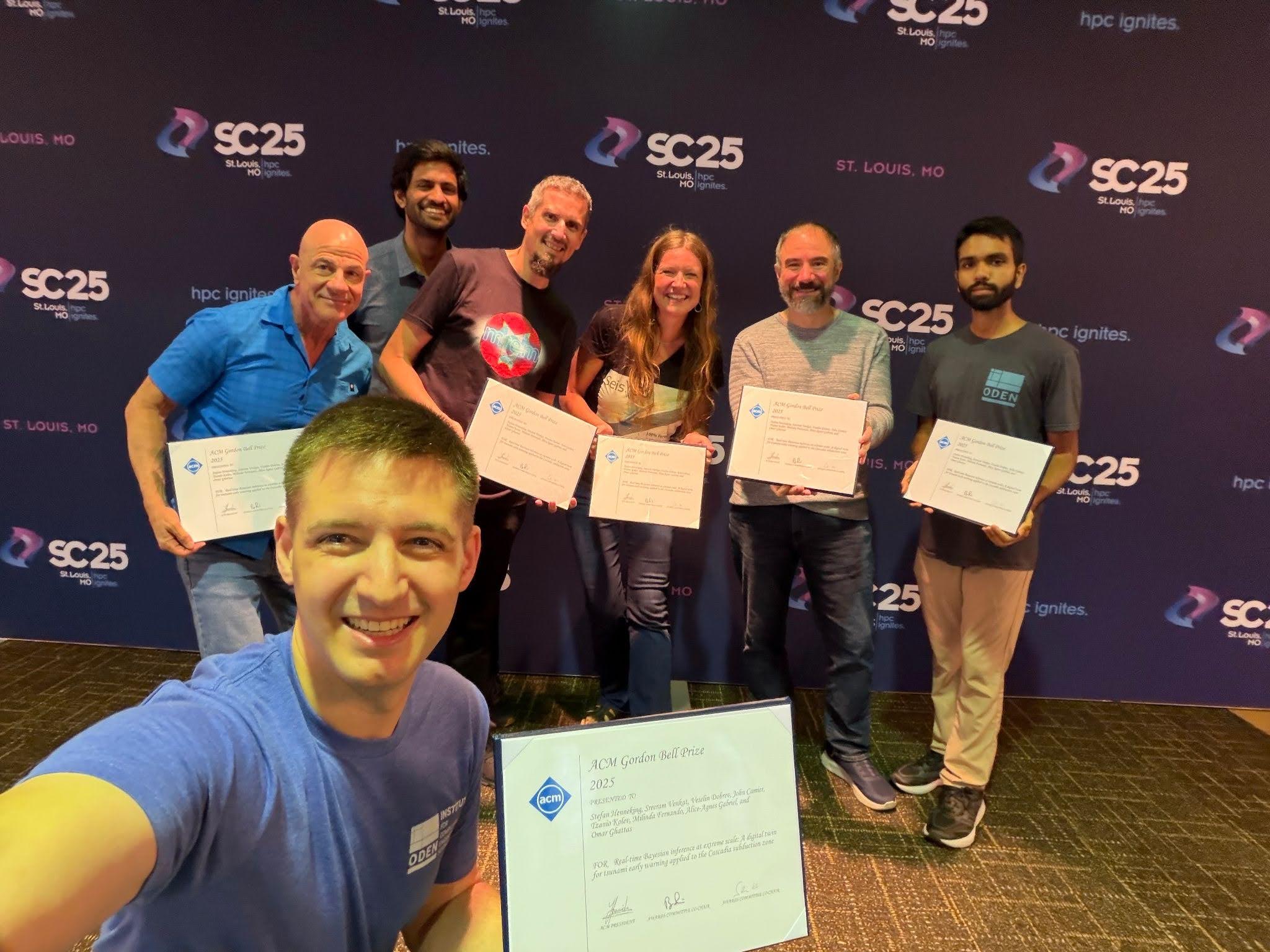
The winning team of the 2025 ACM Gordon Bell Prize at the SC25 conference in St. Louis, MO. In front: Stefan Henneking. In the back (from left to right): Omar Ghattas, Milinda Fernando, John Camier, Alice-Agnes Gabriel, Tzanio Kolev, Sreeram Venkat.

Foundations in computational and applied mathematics have always been paired with an eye toward real-world stakes. For Stefan Henneking, a research associate at the Oden Institute for Computational Engineering and Sciences, creating a digital twin to help predict tsunami impact landed him on the winning team for the Gordon Bell Prize in November 2025, awarded by the Association of Computing Machinery (ACM).

Henneking's path to high-performance computing began in Germany, where he completed his undergraduate degree in Computational Engineering at the University of Erlangen-Nuremberg. Prior to arriving at The University of Texas at Austin, Stefan attended Georgia Tech University where he earned his master's degree in Computational Science and Engineering. 

Now at the Oden Institute, where he graduated from the Ph.D. program in Computational Science, Engineering, and Mathematics in 2021, Henneking continues his research on developing computational methods for large-scale problems. 

A member of both the Electromagnetics and Acoustics Group and the Optimization, Inversion, Machine Learning, and Uncertainty for Complex Systems (OPTIMUS) Center, Henneking develops computational methods with a focus on Bayesian inverse problems, uncertainty quantification, and optimal experimental design. 

In a nutshell this translates to using powerful computer models that help researchers better understand uncertainty, make more reliable predictions, and design smarter experiments — all with the goal of helping communities better prepare for and respond to what Mother Nature throws out.

His foundational research has the potential to help local populations where every second counts, particularly in the Cascadia Subduction Zone, a large fault system off the coast of the Pacific Northwest in the United States. This region is poised for a megathrust earthquake in the coming decades, based on past history. When a magnitude 8–9 earthquake strikes, the window of time between seafloor rupture and tsunami impact on land can be measured in minutes. For these coastal areas, those minutes could make a very real difference when a powerful wall of water is approaching land. 
block.caption

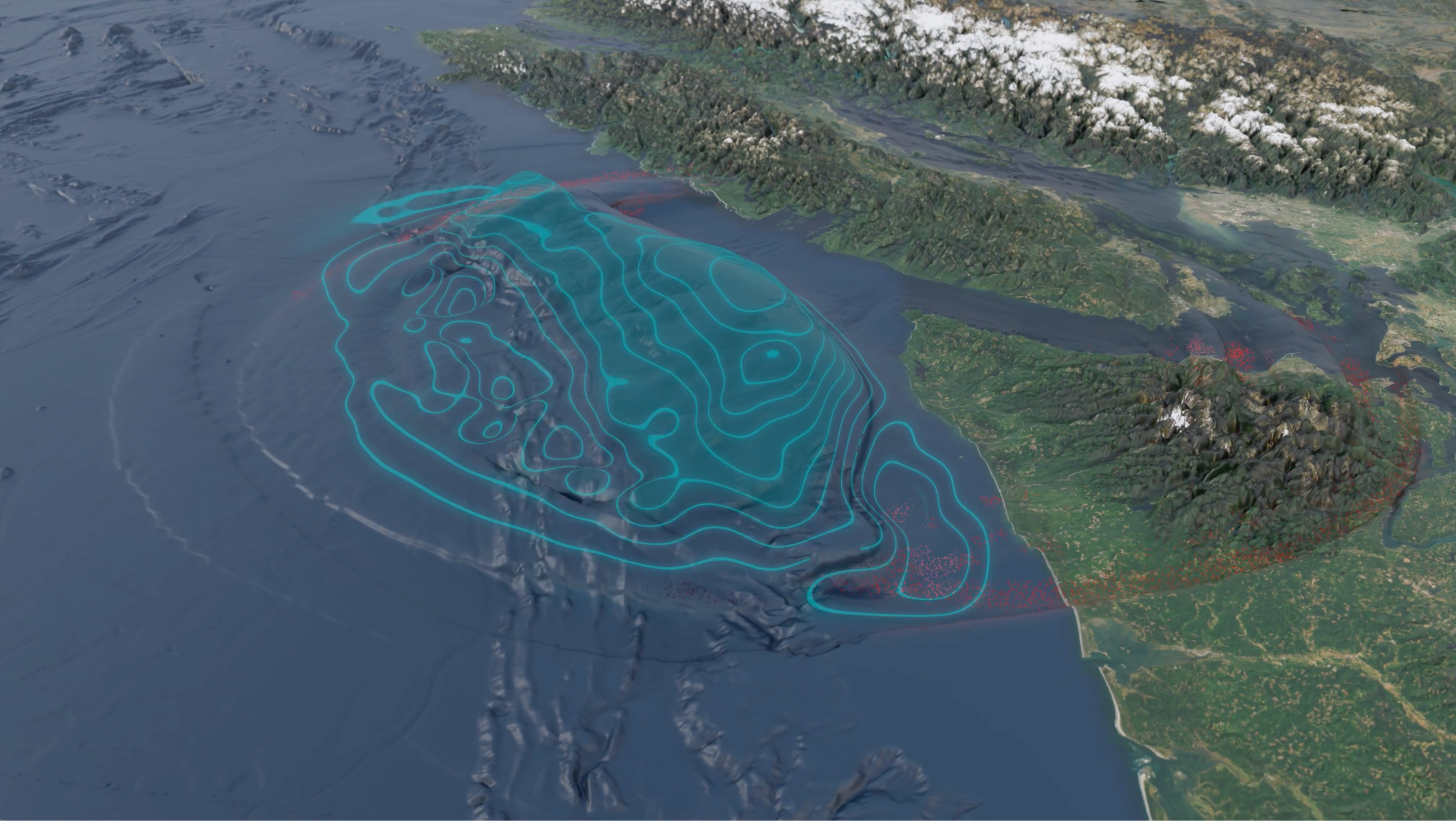
Snapshot of the Gordon Bell Prize-winning team's video entry to the Art of HPC showcase at the SC25. The image depicts earthquake and tsunami simulation results for a magnitude 8.7 earthquake spanning the full margin of the Cascadia Subduction Zone.

The core of the work is a mathematical and computational framework for large-scale Bayesian inference that functions as a physics-based digital twin for tsunami early warning. Given pressure readings from sensors on the seafloor, the system rapidly reconstructs the seafloor uplift and predicts how a resulting tsunami will propagate toward coastlines, all in real time and based on high-fidelity physics rather than simplified approximations. 

The computations that powered this framework ran on some of the largest supercomputers in the world, including El Capitan at Lawrence Livermore National Laboratory (LLNL), currently ranked the world's most powerful supercomputer. The largest runs used 43,520 GPUs simultaneously and solved systems of equations with over 55.5 trillion degrees of freedom, a new world record for unstructured finite element computations, requiring more than five petabytes of memory.

The team's MFEM-based finite element application code, a real-time inversion tool developed by Oden Institute graduate student and collaborator Sreeram Venkat, and a member of the collaborative team for the Gordon Bell Prize, and vendor-optimized GPU libraries provided on supercomputing facilities at Texas Advanced Computing Center (TACC), National Energy Research Scientific Computing Center (NERSC), and Lawrence Livermore National Laboratory (LLNL) all had to integrate flawlessly at scale. 

Getting there required every component of the framework to work in concert. Henneking is candid about how much of that success depended on the people behind the infrastructure. "It's a testament to the dedication of the admin teams at computing centers like TACC, NERSC, and Livermore Computing that we were able to solve problems at this scale," he said.

The moment the results came together is one Henneking remembers clearly. In early 2025, the team ran their framework against realistic Cascadia earthquake scenarios. These scenarios are based on dynamic rupture simulations developed by collaborator Alice Gabriel at University of California, San Diego. When the first large-scale results came back, using synthetic data from a hypothesized seafloor sensor network, the tsunami forecasts were accurate. "At that moment, I knew that the many years of work developing the framework had paid off," he said.

"A competitive entry for the Gordon Bell Prize pushes the limits of what supercomputers can do," Henneking said. "It needs to demonstrate both breakthrough performance and real-world impact." Henneking's team delivered on both. Their framework solved an inverse problem involving over one billion parameters describing earthquake-induced seafloor motion in fractions of a second, a ten-billion-fold speedup over conventional methods.

It's a testament to the dedication of the admin teams at computing centers like TACC, NERSC, and Livermore Computing that we were able to solve problems at this scale.

— Stefan Henneking

Since the prize, the research has continued to expand. In March, Henneking and project lead Omar Ghattas, Director of the OPTIMUS Center, presented at NVIDIA's GPU Technology Conference (GTC) in San Jose, California. The conference is one of the largest AI and high-performance computing events in the world that draws over 30,000 attendees from across industry and research. 

"Being recognized with the Gordon Bell Prize has broadened the visibility of our work within the high-performance computing (HPC) community and beyond," he said. "It has given me the opportunity to meet with public stakeholders like National Oceanic and Atmospheric Administration (NOAA), with industry partners like NVIDIA, and it has opened the door to new collaborations."

On the application side, the team is working with collaborators at University of California, San Diego to develop a digital twin for tsunami early warning in the Japan Trench, the subduction zone responsible for the catastrophic 2011 Tohoku earthquake and tsunami. On the computational side, they are collaborating with LLNL and NVIDIA to push the performance of their finite element simulations further on NVIDIA's newest GPU architectures. 

One of the most important scientific questions the framework is now positioned to answer concerns sensor placement. The Cascadia Subduction Zone currently lacks the seafloor instrumentation that would be needed to deploy the warning system in practice. Installing sensors across a subduction zone stretching more than a thousand kilometers is expensive and makes the question of where to put them, and how many are actually needed, a critical one. Within their Bayesian inversion framework, the team can now address this directly, identifying sensor locations that minimize uncertainty in the forecasts through what researchers call optimal experimental design.

For Henneking, the ambition behind all of it is straightforward. "My goal is that our framework will contribute to designing data-driven, next-generation tsunami early warning systems that are based on full-physics models," he said. "Such systems could significantly improve our current early warning capabilities and may help prevent the loss of life from future earthquake-tsunami events." That kind of tangible, life-saving application is exactly the story he wants to tell.