University of Texas at Austin

News

A Match Made in the Cosmos

Published May 5, 2026

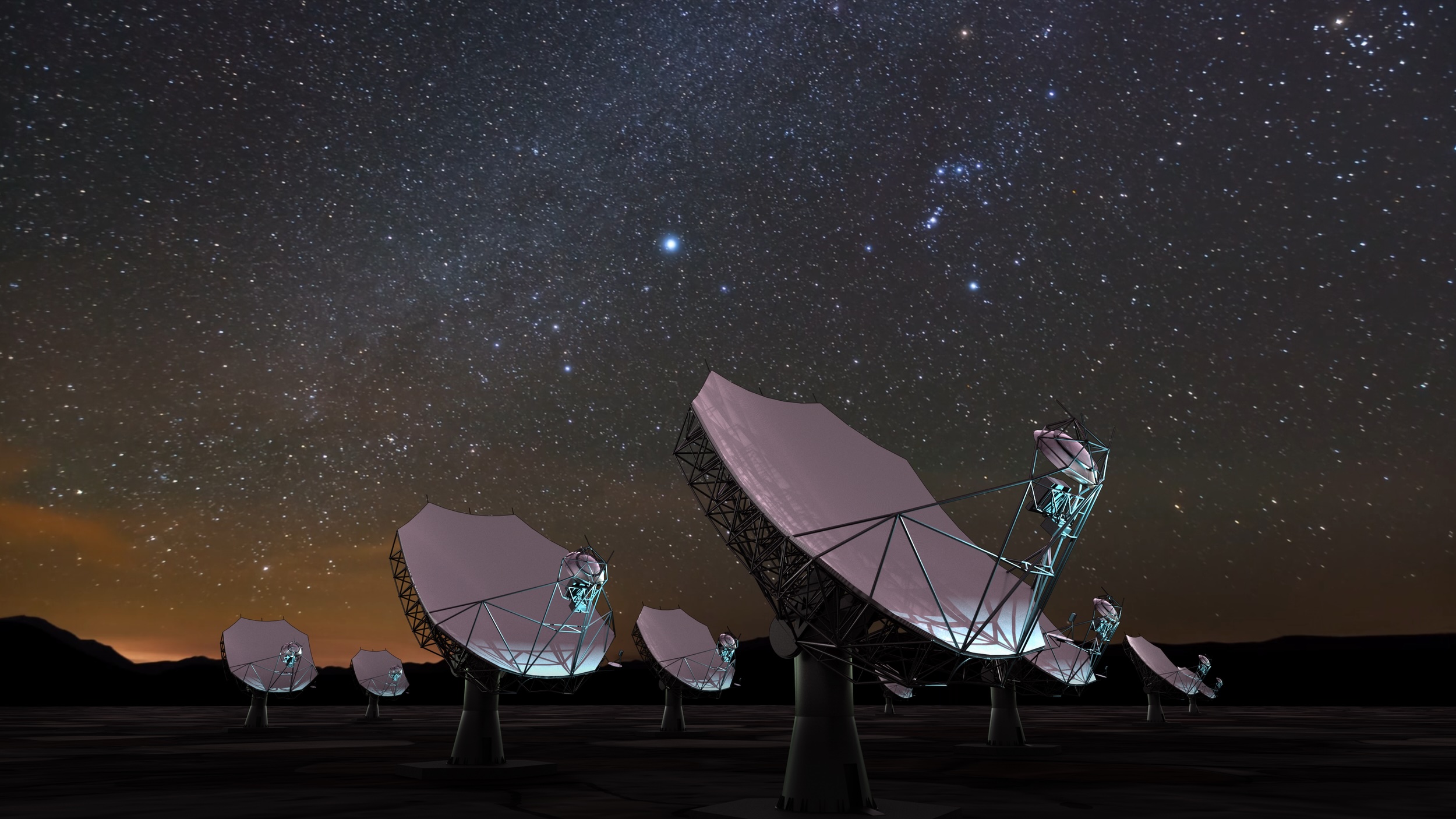
The dishes of ALMA gaze skyward from their mountaintop perch in Chile. CosmicAI is developing techniques to help analyze the array’s mountains of data.

How Astronomy and AI are solving each other’s problems

Astronomy is sitting on a cosmic treasure chest. That treasure is data—petabytes of it. To put that in perspective, a petabyte can hold about 200,000 high-definition movies, 210 million songs, or 256 million high-resolution photos. 

“Astronomers are really good at creating a lot of data really, really fast,” says Eric Murphy, an astronomer at the National Radio Astronomy Observatory (NRAO). And he says the data have some irresistible qualities: They’re free to use, safe, visual, messy, and immense. Essentially, this treasure house is perfect for computer scientists who need massive datasets to train their artificial intelligence (AI) models but often are stuck with overly simplistic data locked behind paywalls. Astronomy also provides a low-risk environment to test AI models: If an algorithm misclassifies a galaxy, nobody gets hurt. 

It’s a match made in the cosmos: Astronomy gets shiny new tools to process its mountains of data, and AI gets a safe playground filled with exciting toys to improve its methods. 

Enter the NSF-Simons AI Institute for Cosmic Origins (CosmicAI), which was established in 2024 to cultivate this symbiotic relationship. 

“The CosmicAI Institute was envisioned as a way to inspire people, gain a better understanding of the universe, develop innovative open-source AI tools for astronomy, and create educational opportunities,” says CosmicAI Director Stella Offner, a professor of astronomy and faculty member in the Oden Institute for Computational Engineering and Sciences, both at The University of Texas at Austin. Offner says that, at the heart of astronomy, lies one of humanity’s most fundamental questions: Where do we come from? 

Spurred by a 2023 executive order about the development of secure and trustworthy AI, the National Science Foundation (NSF) and the Simons Institute (an organization dedicated to studying theoretical computer science) jointly announced a funding call for two national AI institutes in the astronomical sciences. With 25 other AI institutes under its belt, NSF was ready to expand into astronomy’s gold mine. Offner seized the opportunity and CosmicAI was born. 

CosmicAI consists of eight partners across the country: UT Austin, the Texas Advanced Computing Center, the University of Virginia, the University of Utah, New York University, and the University of California, Los Angeles, along with two nationally funded astronomy centers, NRAO and the National Optical-Infrared Astronomy Research Laboratory (NOIRLab). Private collaborators, including researchers at the nonprofit Allen Institute for Artificial Intelligence, also support CosmicAI. Inside the institute, you’ll find astronomers, computer scientists, mathematicians, chemists, linguists, and physicists, each speaking their own language like a modern Tower of Babel. 

Their mission revolves around four grand AI challenges: trustworthiness, efficiency, interpretability, and robustness. A working group tackles each of these challenges: the Observable Universe (efficiency), Explorable Universe (trustworthiness), Accelerated Universe (robustness), and Explainable Universe (interpretability). An AI expert and an astronomer lead each group. A year and a half in, the institute is creating better AI tools for astronomy while attempting to address such fundamental mysteries as the nature of dark matter and the origin of life. But there’s a catch: the treasure is arriving faster than anyone can process it. 

Efficiency: The Observable Universe

Eric Murphy, an astronomer at NRAO and co-principal investigator for CosmicAI, leads the Observable Universe effort. And he says he’s drowning in data. 

The Atacama Large Millimeter/submillimeter Array (ALMA), an array of 66 radio telescopes, sits atop one of the tallest plateaus in a remote desert in northern Chile. It observes low-frequency electromagnetic radiation, collecting data 24 hours a day, 365 days a year. 

Murphy says that in the near future, ALMA will be upgraded to increase its sensitivity, allowing it to see even deeper into the universe. 
With these upgrades and next-generation facilities on the horizon, data volumes will grow to the point that quality assurance can no longer solely rely on humans in the loop.

— Eric Murphy

“We need robust, reliable ways to check the data in a single pass, because repeatedly running it through the usual calibration and imaging steps will be too cost-prohibitive,” he says.

The Observable Universe is creating AI tools to comb through ALMA’s observations, scanning for any abnormalities. The goal is not merely to identify irregular data, but to determine which anomalies actually affect the final, science-ready data products—an approach the team calls consequential flagging. This ensures that only issues that meaningfully impact scientific results are flagged, improving efficiency without sounding the alarm at every minor detail. 

A second major focus for the group is extracting features from large “hyperspectral data cubes,” which are datasets that capture the locations of astronomical objects and their brightnesses across a wide “spectrum” of wavelengths. So, for a given point in the sky, ALMA records the intensity of light in each channel (along with the point’s coordinates) and then stores the slices in a data cube. 

With the upcoming upgrades, these cubes will swell to millions of slices, as the data will be split into many narrower channels, increasing the cost of imaging and analyzing every channel. To mitigate cost, the Observable Universe group is devising techniques to identify which spectral channels are likely to contain real signals and where meaningful features can be identified. 

For example, each molecule produces its own “fingerprint,” which is a pattern of lines in an object’s spectrum. When several fingerprints overlap within the same wavelength range, it can be difficult to sort out which molecules are present. The team plans to devise methods to untangle these heavily blended spectral lines, using laboratory measurements of where each set of lines should appear. Unraveling these lines is crucial to studying starbirth because stars form in chemically rich regions where many molecular fingerprints intertwine. 

Too much data isn’t just an ALMA problem. The Vera C. Rubin Observatory, at the summit of Cerro Pachón, also in Chile, will generate data equivalent to two years of nonstop streaming every single night. That’s a lot of binge-watching, even for a seasoned couch potato. That amount of data is no longer a manageable task for human analysts—using AI is a perfect fit to cull through the vast amounts of information, researchers say. 

Trustworthiness: The Explorable Universe

If the Observable Universe is solving today’s bottleneck, the Explorable Universe is venturing into tomorrow’s possibilities. You probably have heard of large language models (LLMs) like ChatGPT and their tantalizing promises. You probably also have heard of their unreliability: how they hallucinate and how their reasoning often is opaque, hidden in a metaphorical black box. Creating a component of explainability is key. 

block.caption

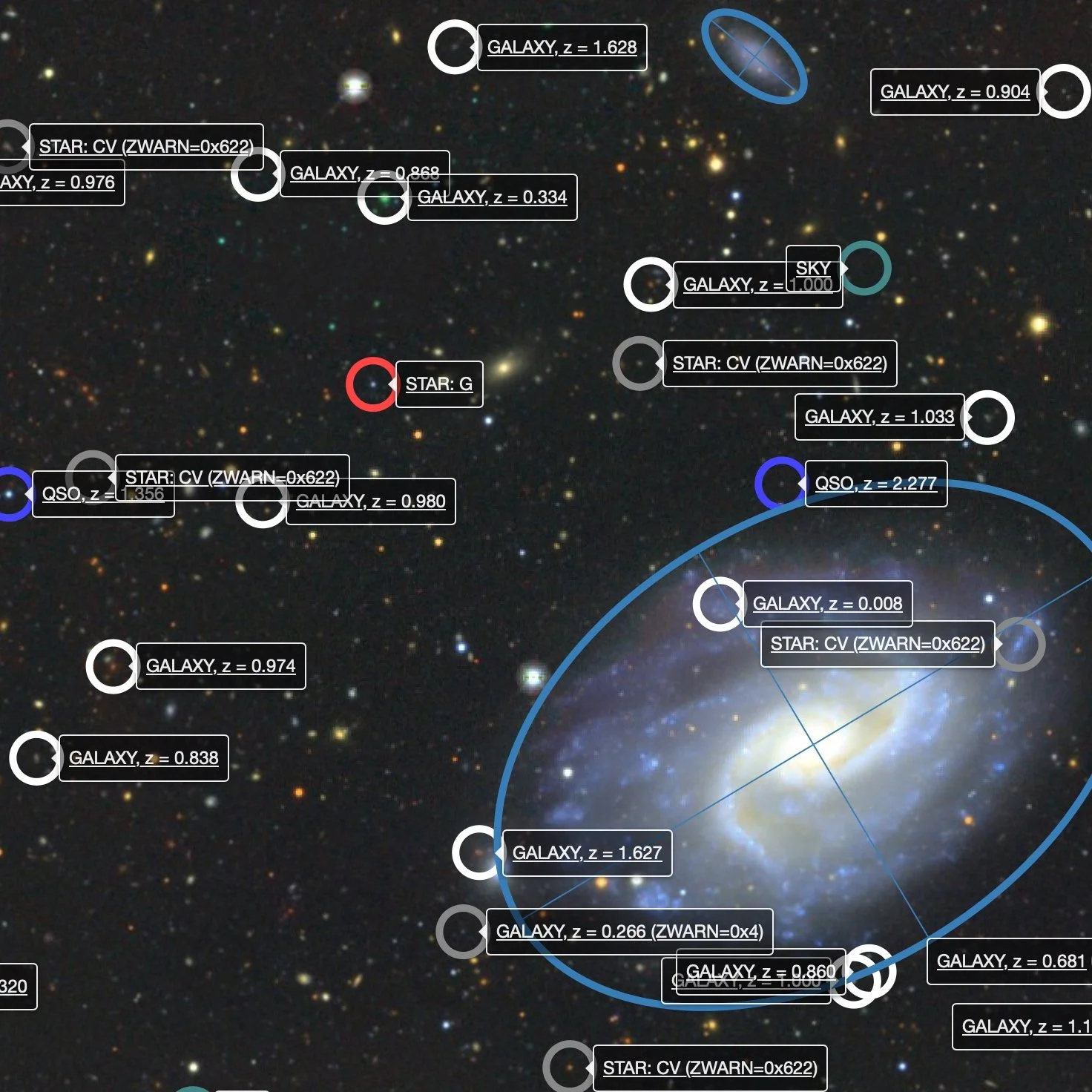
An image that contains many galaxies shows the complexity of analyzing astronomical observations. Courtesy of CosmicAI.

This corner of CosmicAI will confront those challenges by building an AI assistant that astronomers can actually trust. Jessy Li, a professor of linguistics and (by courtesy) computer science at UT Austin and the AI lead of this group, says, “It’s very exciting. We have never had language models that can be this good, so it opens up a lot of very interesting questions for us to answer.” 

As a first step to crafting the ideal AI assistant, the group developed a benchmark to evaluate the quality of existing LLMs. Called AstroVisBench, it serves as a “north star” for the group, guiding its progress toward a reliable astronomical LLM. “The goal of AstroVisBench is to provide a platform to test whether models can transform a natural-language query from scientists into usable code and visualizations,” says Li, who co-authored the AstroVisBench paper. 

To do this, Li and her colleagues extracted almost 900 tasks from notebooks created by astronomers working with data from various observatories. The tasks were divided into two categories: processing and visualization. The processing tasks asked the LLM to write code that could analyze data. Then, the visualization tasks asked the LLM to use its analysis to make relevant figures like bar charts and scatter plots. Researchers fed both tasks to leading LLMs and executed their output code. 

The LLMs’ performance was disappointing across the board. Even the best-performing model produced code that crashed roughly 30 percent of the time on data processing tasks, and produced error-free visualizations less than 16 percent of the time. Some code failed to run at all. Some ran but completely missed the point of the query. “Most models these days can get you very far in general-domain questions,” Li says. 

“It can be your average assistant, but once you transition to very specific domains and deep knowledge, you start to see things crumble.”

— Jessy Li

With AstroVisBench complete, Li can concentrate on more intriguing hurdles standing between today’s clunky chatbots and tomorrow’s trustworthy research partners. 

The first hurdle: understanding the scientist’s intent. Mind-reading is really hard. When an astronomer asks, “What wavelengths of light can see through nebulae?” a good assistant would know not to respond in units of football fields. 

“There’s still this gap,” Li says, “if the model can fully understand the scientist’s intent: What is necessary, what should be visualized, what should be calculated, in ways that align with their workflow.” Humans communicate with subtext and shared assumptions. AI is that friend who takes everything literally and still doesn’t get why you’re laughing. 

Another hurdle is that creativity is not AI’s strong suit. If an astronomer asks ChatGPT to brainstorm ways to analyze exoplanet atmospheres, they will get a dozen variations of the same idea, each phrased slightly differently. “Models lack diversity in their outputs, which could impede their use for brainstorming,” Li says. For astronomers who want an assistant to help them think outside the box, getting a dozen identical boxes back is not that helpful. 

Robustness: The Accelerated Universe

Meanwhile, the Accelerated Universe group is piercing through the cold, dense nurseries where stars and planets are born amid harsh radiation and turbulence. These hostile environments can’t be replicated in a lab or seen clearly by telescopes, so to understand the chemistry that occurs deep inside them, astronomers must rely on computer simulations. As Arjun Vijaywargiya, a postdoctoral fellow at the Oden Institute and CosmicAI fellow under the Accelerated Universe, puts it, “Computer simulations of collapsing interstellar clouds of gas and dust let astronomers ‘rewind and replay’ star and planet birth, revealing how the interplay of physics and chemistry shapes the worlds that emerge.”

But realism is expensive. Because these dark clouds host hundreds of atoms and chemical compounds that undergo thousands of reactions, chemistry often is simplified, or omitted entirely, in favor of keeping costs affordable. “High costs force most simulations to either limit the number of chemicals and reactions they consider or to relegate chemistry to post-processing instead of incorporating it into the simulation,” Vijaywargiya says. Although these simplifications are cheaper, stellar nurseries are some of the universe’s busiest chemical regions, so to recover the missing chemistry without causing prices to soar, the Accelerated Universe is turning to a type of AI-assisted simulation known as surrogate modeling. 

The technique trains machine-learning models to approximate expensive computer simulations. 

“Historically, when we model physical systems, we have a set of physical equations that represent their behavior, and we use large supercomputers to solve those equations,” says Offner, who serves as the astronomy lead for Accelerated Universe. “And the equations, while maybe not exact, are a direct representation of the physics that describes that system. AI allows us to build a shortcut, where instead of directly solving the equations, we learn the behavior of the system and use that learned behavior to predict how that system will evolve.” 

To keep these shortcuts accurate, Accelerated Universe is developing analysis techniques that help determine which parameters are the most important, enabling the surrogate model to stay faithful to physics while tracking fewer variables. For example, Vijaywargiya is building a surrogate model that tracks only the most consequential chemicals, keeping simulations accurate without breaking the bank. 

But small errors introduced at the beginning can rapidly snowball and become enormous at long time scales. It is the same reason why you don’t check the weather forecast for six months from now; that “partly cloudy” prediction is about as reliable as a TikTok psychic. Accelerated Universe manages these uncertainties with special methods. 

With these guardrails in place, Offner, Vijaywargiya, and their collaborators in the Accelerated Universe group will apply robust surrogate modeling to study the chemical precursors to life: When and where do the molecules that are crucial to life arise? Unveiling these may help us understand how, in spite of the universe’s animosity, life came to be. 

block.caption

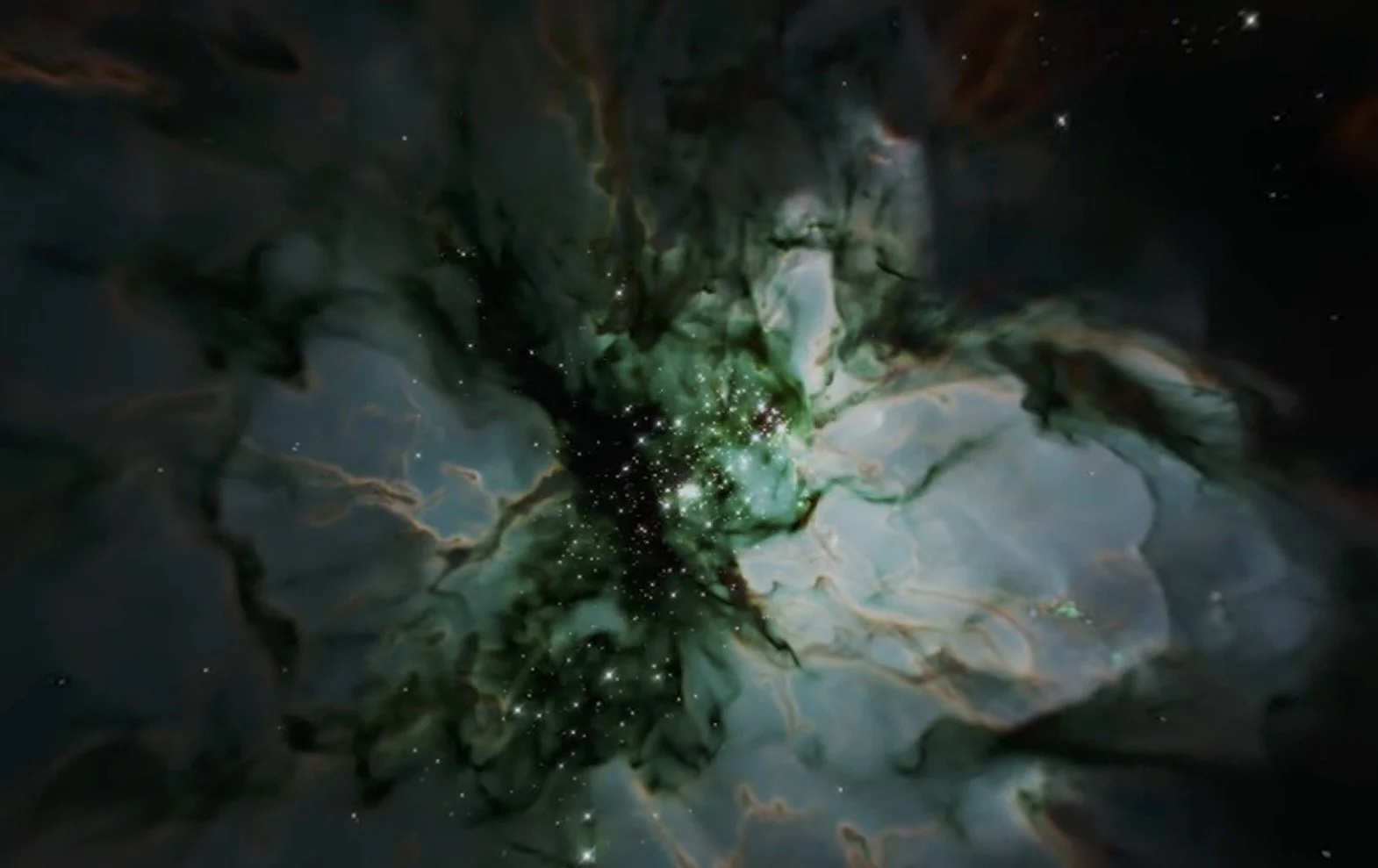
A simulation of a star-forming cloud from the Starforge Collaboration. Courtesy of CosmicAI.

Interpretability: The Explainable Universe

While Accelerated Universe focuses on building AI-driven simulations to understand our cosmic origins, Explainable Universe focuses on understanding the simulations themselves. “We run AI models to test our theories and interpret observations, but the Explainable Universe group wants to run AI models as intelligently as possible and maximize the information we extract,” says Alex Garcia, a graduate student at the University of Virginia and a member of CosmicAI’s Student/Postdoc Leadership Council. 

That distinction matters because, for scientists, accurate predictions alone are not enough. AI models can reveal statistical correlations in data (such as a link between the amount of oxygen in a galaxy and the galaxy’s mass), but correlation does not imply causation. Without understanding why a model produces a given result, astronomers risk mistaking patterns invented by algorithms for laws of physics. “If I showed ChatGPT or whatever model an image of a galaxy and it told me how that galaxy evolved, I would really like to know why,” Garcia says. 

“We don’t just want answers with no context—we want to build that context up.”

— Alex Garcia

To accomplish this, Garcia and his colleagues are developing AI methods that can identify true cause-and-effect relationships. 

One important approach is called parameter sensitivity analysis. It investigates how changes in a model’s variables affect its results. 

The goal of this analysis is to reveal which factors actually matter. For example, galaxy simulations that study dark matter typically involve five to nine parameters, such as the strength of winds caused by swirling disks that surround supermassive black holes. Exploring every possible parameter combination through traditional simulations would not be feasible, even with today’s modern supercomputers. Instead, the group uses traditional methods to sparsely sample the set of all possible values for the parameters and then uses AI to fill in the gaps. This allows astronomers to determine which parameters reflect real physics and which are illusory features that arise from limitations in the simulation. 

Garcia and the rest of the working group apply this approach through DREAMS (DaRk mattEr and Astrophysics with Machine learning and Simulations), a suite of simulations designed to investigate the nature of dark matter. Dark matter appears to make up 85 percent of all the matter in the universe, yet it produces no detectable energy. We know it exists only because it exerts a gravitational pull on the visible matter around it. Despite its abundance, dark matter remains one of astronomy’s most stubborn and perplexing mysteries. 

One popular explanation is the Cold Dark Matter model, which successfully explains some features of the universe but not others. The theory and its alternatives predict different effects at smaller scales, particularly in the inner regions of individual galaxies. The problem is that those predicted differences can be subtle and easily mimicked by other processes and events, such as exploding stars. 

By varying both dark-matter properties and galaxy-formation physics, then training AI to identify patterns, the team aims to distinguish genuine dark matter effects from astrophysical shams. “We want to make testable predictions that should validate these different models one way or another and provide a reason why this rules out one model or favors another,” Garcia says. 

A Collaborative Environment

CosmicAI’s groups address different needs in astronomy, but their solutions and methods overlap. Observable Universe sifts through petabytes of incoming data, separating signal from noise before the data flood becomes unmanageable. Explorable Universe is developing a trustworthy AI assistant that astronomers can rely on. Accelerated Universe is building simulations rigorous enough to incorporate chemistry and reveal how life’s building blocks emerge in hostile stellar nurseries. And Explainable Universe will ensure that those simulations reveal genuine physics rather than numerical artifacts, using dark matter as its testing ground. 

These teams are advancing the frontiers of artificial intelligence in ways that may translate beyond the expansive field of astronomy. Because complex systems are inherently interconnected, improvements in trust, reasoning, efficiency, and understanding strengthen the whole. Seeking answers to the fundamental questions of the universe requires collaboration across many disciplines, and that collaborative spirit may prove as valuable as the discoveries themselves.