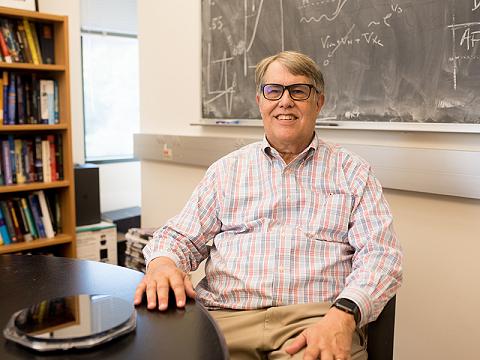
University of Texas at Austin faculty James Chelikowsky once heard a Nobel Laureate describe how they stumbled into their biggest discovery. The lesson he took away was simple: breakthroughs rarely come to those who stay in their lane. It is a philosophy that has guided six decades of research crossing disciplinary boundaries in computational science, and one Chelikowsky finds himself thinking about now as he enters retirement.
Professor of physics and chemical engineering and the W.A. "Tex" Moncrief, Jr. Chair of Computational Materials at the Oden Institute for Computational Engineering and Sciences where he leads the Center for Computational Materials, Chelikowsky has spent his career using computer modeling to predict the properties of materials before they are ever created in the laboratory.
"I've been fortunate to work in a field that I enjoy," he said recently. That much is evident. His work has shaped how the field thinks about nanoscale materials, opened new frontiers in materials discovery using artificial intelligence, and helped establish computational approaches that are now standard across the discipline.
Chelikowsky grew up in Manhattan, not the Big Apple of New York, but the "Little Apple," home to Kansas State University, where his father was a geology professor. Both Chelikowsky and his brother followed him there as a matter of course. Growing up in the 1950s, he watched one of the first satellites cross the night sky and felt the wave of scientific enthusiasm it ushered in. After exploring a range of sciences, he settled on physics, drawn both to its challenge and to the way it distinguished him from his engineer brother and geologist father.
After graduating in 1970, he left Kansas for the first time, heading to the University of California, Berkeley, for graduate school. He arrived nervous, surrounded by students from renowned universities: California Institute of Technology, Harvard, Massachusetts Institute of Technology, and Yale. The anxiety did not last long. On his first quantum mechanics exam, he recognized a problem from his undergraduate coursework and earned the highest grade in the class. It would not be the only time.
At Berkeley, he worked under Marvin Cohen, one of the world's most cited theoretical physicists and a foundational figure in computational physics. "It was very fortuitous because Marvin combined two things that were very appropriate for the time and place: he was one of the first people to use computational tools to examine and predict materials' properties, and he was very interested in semiconductors."
The work they did together pushed the field in a new direction. Until then, semiconductor research was largely limited to crystalline materials, whose high symmetry made computation manageable. Cohen's group developed techniques that extended those methods to nonperiodic systems, materials without repeating structures. "That opened up a window to all sorts of materials, which heretofore nobody had done," Chelikowsky said. The hours he put in matched the ambition. He was regularly spotted in the computer room at three in the morning or on weekends. "I worked nearly every waking moment," he said. "And in turn, Cohen looked after me. He knew that if I did well, it helped him, and he also knew that it was his job to do the best he could in educating and placing his students."