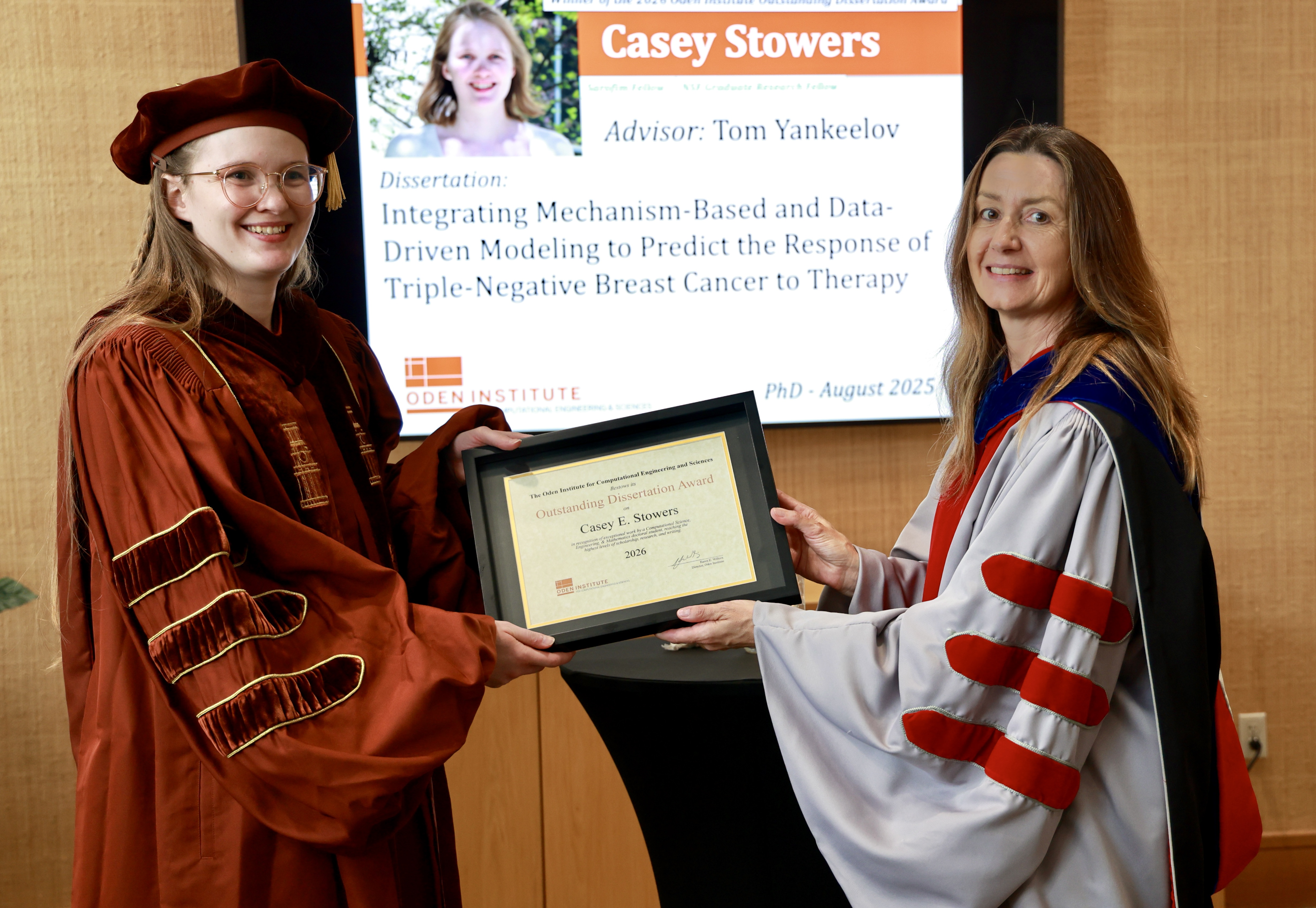
Triple-negative breast cancer (TNBC), an uncommon subtype of cancer, gets its name from what it lacks: overexpression of three receptors that could have facilitated targeted treatment. Recent Ph.D graduate Casey Stowers’s dissertation is also structured as a trio: three aims that address what can be done in the wake of these vacancies.
Stowers’s dissertation, “Integrating mechanism-based and data-driven modeling to predict the response of triple-negative breast cancer to therapy,” was the culmination of her Ph.D. research at the Oden Institute for Computational Engineering and Sciences and earned her the institute’s 2026 Outstanding Dissertation Award. The award recognizes exceptional research that is impactful, original, and cutting-edge. Her advisor, Tom Yankeelov, who directs the Center for Computational Oncology, said she deserves this award for “the thoroughness and completeness with which she attacked and solved problems.” He added, “When Casey goes after a problem, if humans are capable of solving it, then Casey will solve it.”
While pursuing her Computational Science, Engineering, and Mathematics (CSEM) Ph.D., her goal was to build a more accurate and efficient model to improve the predictions of TNBC response to therapy. In TNBC, the patient lacks overexpression of those key receptors, which means that they cannot benefit from targeted drugs. Instead, these patients generally need systemic therapies like chemotherapy that attack all of their cells, resulting in dramatic side effects. Stowers wanted her model to support therapy optimization: killing the most cancer while minimizing the side effects.
Professor Yankeelov said, “As there are currently no accepted methods of predicting the response an individual patient will achieve with a particular therapeutic regimen, it is difficult to overstate the importance of predicting and optimizing the response of cancer to therapy.” He also added that “the mathematical and computational formalism she developed applies to any cancer for which the requisite data is available. Thus, her work has an impact beyond “just” breast cancer.”