Feature
George Biros receives grant to lead research on large scale algorithms for uncertainty quantification
Published Oct. 8, 2013
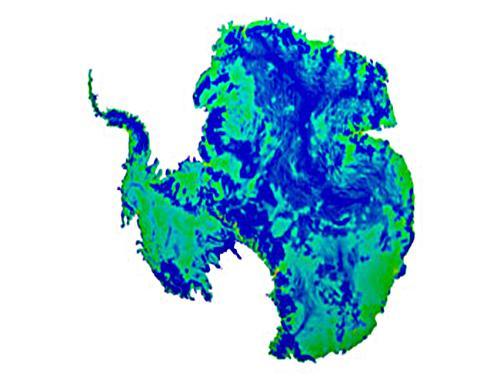
[[The U.S. Department of Energy has awarded $2.85 million to George Biros at The University of Texas at Austin to quantify uncertainties in large-scale computer simulations, including models of the melting Antarctic ice sheet.
Simulating complex natural or engineered systems to resemble reality can require billions of parameters “each of which can be uncertain,” says Biros, a professor at the Institute for Computational Engineering and Sciences (ICES). “So estimating the overall uncertainty of the outcome, can be quite challenging.”
 Biros, a high performance computing expert, will lead a team of researchers focusing on three specific systems of keen interest to the U.S. Department of Energy: the melting of continental ice sheets in Antarctica, complex fluid flows (such as what’s observed in potential algae biofuels), and complex multi-scale materials. Read more.]]
These three systems are already the focus of three other ICES faculty who will contribute: Omar Ghattas, who directs the ICES Center for Computational Geosciences, Robert Moser, who directs the ICES Center for Predictive Engineering and Computational Sciences, and J. Tinsley Oden, who leads the Multiscale Modeling Group as well as serving as ICES director. Tan Bui-Thanh, an ICES research scientist and assistant professor in aerospace engineering and engineering mechanics, is also on the team as co-principle investigator.
In addition to the ICES researchers, Massachusetts Institute of Technology aeronautics and astronautics professor Youssef Marzouk will be contributing mathematical and algorithmic innovations in all areas, and Jeffrey Vetter, leader of the Future Technologies Group at Oak Ridge National Laboratory, will aid in scaling the new methodologies to supercomputers, such as those at UT’s Texas Advanced Computing Center.
“It’s a lot of effort just to run one simulation. It requires new algorithms and technologies,” Biros said, who is also a professor of mechanical engineering. “So that’s why we need all this knowledge that has already been developed and can be applied to these uncertainty estimation techniques.”
The mathematical structure that defines simulations of physical systems is for the most part well known, Biros said. It’s the imprecise, or unaccounted input values that cause uncertainty to arise. When dealing with large-scale simulations, even a relatively small number of unknowns can have significant effects on model accuracy as they propagate through the system.
A familiar example of the effects of uncertainty in simulation is the cone-like shape predicted paths of hurricanes, Biros said.
“You typically see the cone opening as you look into the future,” Biros said. “Which means whatever small perturbation that you have gets amplified so you’re more and more uncertain about the future.”
Currently, most uncertainty research has focused on small-scale systems with relatively few parameters using software that can be run on laptops. The algorithms and technologies that Biros is developing for complex systems, on the other hand, require the high-processing power of supercomputers.
Besides being directly related to energy applications and interest, the three systems also serve as models for many other complex systems, Biros said.
“There are many other problems founded by theory that have very similar structures,” Biros said. “We believe that if we are successful with these applications, this technology, with modifications, will be transferable to other systems.”
Biros is a two-time winner of supercomputing’s highest honor, the Gordon Bell Prize, awarded by the Association for Computing Machinery. He leads the ICES Parallel Algorithms for Data Analysis and Simulation Group, and holds the endowed position of W. A. “Tex” Moncrief, Jr. Simulation-Based Engineering Science Chair II.