University of Texas at Austin

News

Oden Institute Welcomes Largest Ever Class of Peter O'Donnell Jr. Postdoctoral Research Fellows

Published Aug. 18, 2026

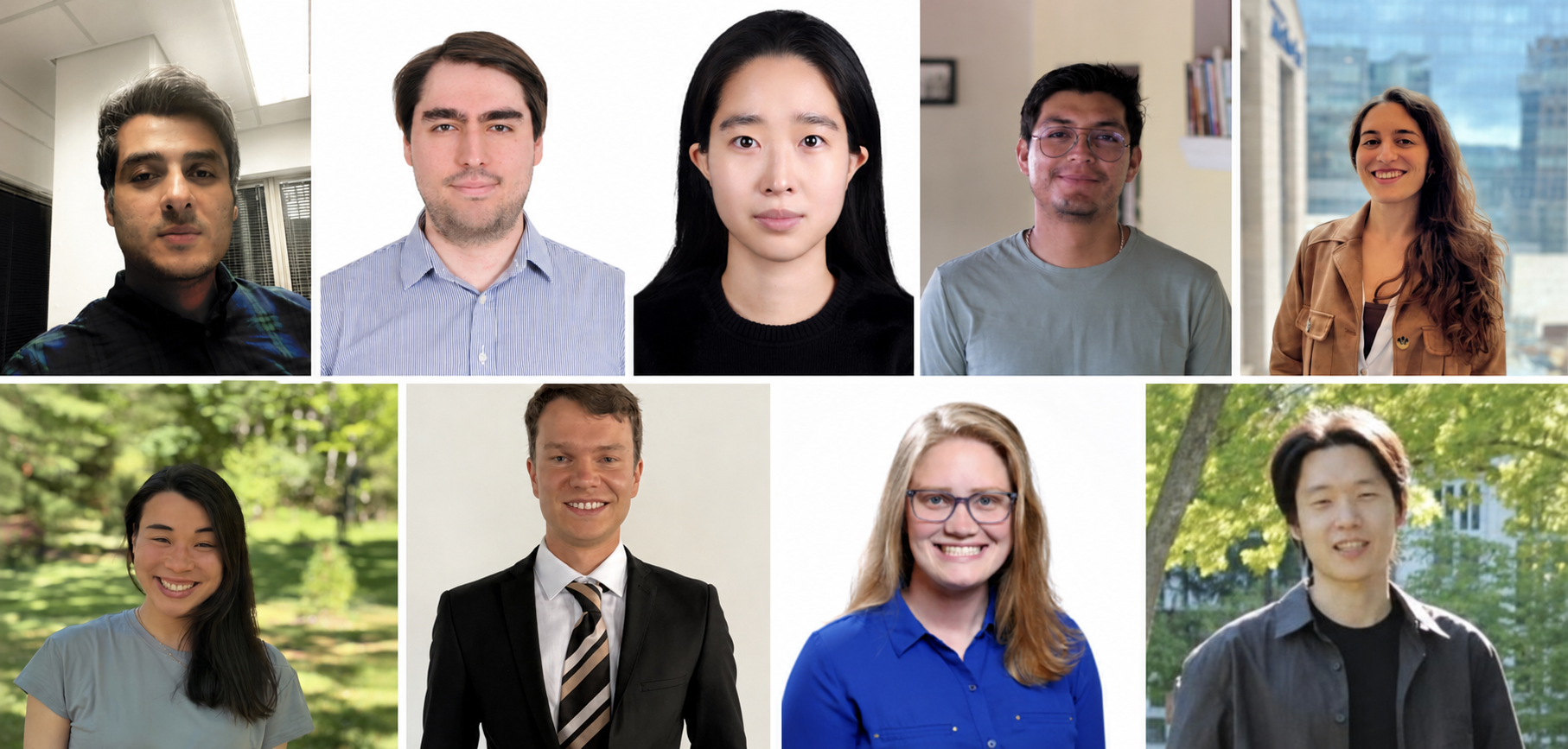
L-r: Vahid Badrkhani, Samet Demir, Jeewon Kim, Alam Tonaltzin Osorio Delgadillo, and Elisa Serafini. Bottom row, l-r: Caroline Tatsuoka, Yannis Voet, Emily Williams, and Jiaqi Yang.

The Oden Institute for Computational Engineering and Sciences is excited to welcome the largest ever group of Peter O'Donnell Jr. Postdoctoral Research Fellows for the 2026-27 academic year. Meet this year's cohort, who bring expertise spanning numerical linear algebra, biomedical imaging, computational oncology, scientific machine learning, and earth system modeling, along with overall enthusiasm to explore Austin and the local food scene. Established in 2001, the O'Donnell Fellowship Program supports recent Ph.D. graduates to engage in interdisciplinary research with world-renowned Oden Institute faculty at The University of Texas at Austin.
 

Vahid Badrkhani

After earning multiple degrees in aerospace engineering, Vahid Badrkhani left Iran to pursue a Ph.D. in computational mechanics at the Technical University of Darmstadt in Germany, where he developed advanced numerical methods and scientific software for simulating fluid flows. He then remained in Germany, taking various research positions in computational fluid dynamics. Now he is trekking across the Atlantic Ocean to work under Jesse Chan, associate professor of aerospace engineering and engineering mechanics and principal faculty member at the Oden Institute.

At UT, Badrkhani will continue to build computational tools to model fluid systems that have traditionally been too expensive or too complex to study. While his research has applications in traditional aerospace fields such as combustion, it has the potential to advance work in areas like biomechanics and medicine. He hopes the Oden Institute's interdisciplinary environment will help foster these broader collaborations and applications.

"The O'Donnell Fellowship offers a unique opportunity to pursue ambitious research while collaborating with world-class researchers," Vahid said. "It is internationally recognized for advancing computational science, and I am excited to contribute to an environment where fundamental mathematical research leads to impactful applications in science and engineering."

Samet Demir

According to Samet Demir, "much of neural networks' practical success has outpaced the mathematical understanding of them." Through his research, he hopes to close that gap.

During his Ph.D. in Computer Science and Engineering at Koç University in Istanbul, Turkey, he broadly studied how modern neural networks learn from data so efficiently. Demir will work under Blake Bordelon, an incoming assistant professor who will hold a joint position at the Oden Institute and the Department of Neuroscience. Demir will investigate the dynamics of learning, specifically "how deep learning models build their internal representation of data over the course of training." He noted, "Understanding this process would make it possible to anticipate how these systems behave rather than relying on trial and error, which becomes increasingly important as they are applied to scientific and engineering problems." Although Demir knows the general problem he wants to address, he remains open to different research directions.

Demir is excited to tap into the excellent resources accompanied by the O'Donnell Fellowship, especially the Texas Advanced Computing Center (TACC) and network of rigorous researchers.

Jeewon Kim

Jeewon Kim pursued her Ph.D. in electrical and electronics engineering at Korea Advanced Institute of Science and Technology (KAIST), driven by one goal: improve MRI imaging. Using physics-based machine-learning methods that she developed, she reduced long scan times and image artifacts that can distort scans.

For her postdoctoral research, Kim hopes to use her expertise in MRI physics, deep-learning algorithms, and computational modeling to hone in on cerebral aneurysm (CA) treatments. CA is a bulging spot on an artery wall in the brain that can cause life-threatening complications like vasospasm and stroke. "While rapid treatment is recommended, there is no consensus regarding ideal timing or method due to the complex interplay between time-to-treatment and other risk factors," Kim explains. "Therefore, the ability to model aneurysm geometry and leverage this information to predict post-treatment outcomes and complications is essential for optimizing both current and emerging interventional approaches."

Under the supervision of Michael S. Sacks, professor of biomedical engineering, director of the Willerson Center for Cardiovascular Modeling and Simulation, and principal faculty member at the Oden Institute, Kim will develop a non-invasive, patient-specific MRI framework that integrates deep learning to mathematically model cerebral wall mechanics and blood flow. "The unique synergy of this specific research group allows me to bridge advanced methodology with clinical reality in a way that wasn't possible before," Kim says. "The Oden Institute gives me the exact platform I need to fully achieve my goal of extending and translating technical solutions into actual patient care."

In addition to the world-class faculty, Kim looks forward to collaborating with faculty at the Dell Medical School and exploring the "legendary BBQ" in Austin.

Alam Tonaltzin Osorio Delgadillo

Alam Osorio's academic journey has taken him across the globe. After earning a bachelor's degree in nanotechnology in his homeland of Mexico, he continued his studies in France and Belgium, completing a master's degree before earning a Ph.D. in physics at École Polytechnique in France. He now brings this international perspective to Austin, where he will begin his postdoctoral fellowship under Antonios Alvertis, assistant professor of physics and principal faculty member at the Oden Institute. Osorio reflected on his international experience, saying, "Working with many people from different cultural backgrounds has helped me approach problems from new perspectives and consider ideas that others might not think about."

Osorio applies these diverse perspectives to materials science research. "Ever since I was a kid, I was inspired by physics and chemistry, and I just happened to be good at them. Studying materials was the tangible application of those interests," he says. Specifically, Osorio has investigated how materials respond to electricity and light, developing physics-based code to model material behavior with greater accuracy and lower cost, and he will extend this line of research at the Oden Institute. He hopes that his first-principles computational models will enable experimentalists to obtain material properties more economically, reducing the time and cost associated with laboratory testing and with general applications in electronics.

"There are so many great minds at the Institute," he shared. "I look forward to collaborating with these great researchers." Additionally, having never been to Austin before but loving photography and hiking, Osorio is incredibly excited to explore the scenic Texas trails.

Elisa Serafini

Elisa Serafini earned her Ph.D. in applied mathematics through a joint program between La Rochelle University in France and the Houston Methodist Research Institute in Texas. Her doctoral dissertation focused on integrating computational models with experimental approaches to improve the accuracy and real-world applicability of laboratory research in heart disease and cancer.

Serafini will work with Tom Yankeelov, professor of biomedical engineering, director of the Center for Computational Oncology, and principal faculty member at the Oden Institute, and David Hormuth, research scientist at the Center for Computational Oncology, with close collaboration with MD Anderson Cancer Center and the Texas Advanced Computing Center. Her research will focus on developing digital twins and virtual patient cohorts, computational models built from clinical data to stand in for real patients in trial simulations, for breast cancer, combining clinical data and mechanism-based modeling to advance personalized treatment planning and improve the efficiency of oncology clinical trials.

"There is no better environment than the Oden Institute, particularly the Center for Computational Oncology, for this kind of work," Serafini said. "The opportunity to work within this group while collaborating closely with physicians and researchers at MD Anderson is especially compelling."

Outside of research, Serafini is looking forward to Austin's outdoor scene and has plans to explore the hills, run on the UT track, try country dancing, and work her way through the local tacos and BBQ.

The quality of the Oden Institute's faculty in my field of research clearly stood out from other places I had applied to,...the Institute offers a stimulating environment for collaborating with outstanding scientists.

— Yannis Voet

Caroline Tatsuoka

Caroline Tatsuoka joins the Oden Institute after completing her Ph.D. in Applied Mathematics at Ohio State University, where her research focused on machine learning methods for uncertainty quantification in complex systems with scarce or noisy data.

Tatsuoka will work with Hannah Lu, assistant professor of aerospace engineering and engineering mechanics and faculty member at the Oden Institute, and Karen Willcox, professor of aerospace engineering and engineering mechanics and Oden Institute Director, on reduced order modeling, a class of methods that enable efficient, real-time prediction in computationally expensive systems. Her research will focus on developing adaptive and composable reduced order models that exploit existing models of a system's subcomponents, ultimately supporting uncertainty-aware decision-making at the full system level.

A prior collaboration with Lu during the previous semester gave Tatsuoka a firsthand look at the environment she was stepping into. "I was able to experience her passion for her research, as well as her kind and helpful mentorship," she said of Lu. "Professor Willcox is a role model, and I am very excited for this opportunity to work and learn from her expertise in model reduction."

Originally from Ohio, Tatsuoka is looking forward to life on the Forty Acres, building relationships with fellow postdocs and students, and, by her own account, watching the Ohio State and UT Austin football game this fall.

Yannis Voet

Yannis Voet earned his Ph.D. in applied and computational mathematics at EPFL, the Swiss Federal Institute of Technology in Lausanne, where he pivoted from an initial focus in civil engineering. His doctoral research focused on developing numerical methods for solving the equations that govern physical systems, with particular emphasis on computational techniques that speed up simulations of how structures respond to dynamic forces.

Voet will work with Per-Gunnar Martinsson, professor of mathematics, Oden Institute Deputy Director, and principal faculty member at the Oden Institute, on problems in numerical linear algebra, including eigenvalue problems, low-rank factorizations, and matrix and tensor equations, with a focus on randomization techniques that have recently reshaped the field.

"The quality of the Oden Institute's faculty in my field of research clearly stood out from other places I had applied to," Voet said. "The Institute offers a stimulating environment for collaborating with outstanding scientists. This prospect is most exciting!"

An avid runner and cyclist with little enthusiasm for Swiss winters, Voet is looking forward to Austin's warmer climate and has heard good things about the city's endurance sports community.

Emily Williams

Emily Williams joins the Oden Institute after completing her Ph.D. in computational science and engineering at Massachusetts Institute of Technology, where she worked on stochastic and generative modeling approaches for multiscale chaotic systems governed by differential equations. Throughout her doctoral work, she was a Department of Energy Computational Science Graduate Fellow and collaborated with the Computational Mathematics Group at Pacific Northwest National Laboratory.

Williams will work with Karen Willcox, professor of aerospace engineering and engineering mechanics and Oden Institute Director. Her research will focus on combining mathematics, physics, and data to make simulations of multiscale systems more efficient and predictive, with particular applications in uncertainty quantification and data assimilation for digital twins.

"The O'Donnell Fellowship is an excellent opportunity to pursue novel research in challenging scientific computing endeavors and explore applications to complex large-scale problems in science and engineering," Williams said. "I am excited to join the dynamic research ecosystem and contribute to interdisciplinary collaboration at the intersection of mathematics, computing, and engineering."

After five years in New England, Williams is looking forward to Austin's sunny weather, the surrounding biking trails, and the city's live music scene.

Jiaqi Yang

Jiaqi Yang completed her Ph.D. in mathematics at Emory University, where she worked on computational modeling of type-B aortic dissections to identify predictive biomarkers for how dissections progress over time.

Yang will work with Umberto Villa, professor of biomedical engineering and principal faculty member at the Oden Institute, on PDE-constrained inverse problems and biomedical imaging. Her research will focus on photon transport models for quantitative optical imaging, tumor perfusion estimation, and brain mechanics, with the broader goal of turning emerging imaging modalities into tools for diagnosis and treatment planning.

"The Oden Institute is one of the few places that brings applied mathematics, scientific computing, and clinical translation together at this scale and depth," Yang said. "I also expect to interact with faculty across Oden and biomedical engineering whose work touches imaging, tumor modeling, and biomechanics, which fits the cross-cutting nature of the projects."

After several years of intensive Ph.D. work, Yang is looking forward to starting fresh in Austin, both in her research and in the city itself.